Practical guide
Kueh Bahulu and Ang Ku Kueh Moulds: What Museum Records Tell Us
Compare two identified Singapore museum moulds: the baulu charcoal-lid arrangement and a wooden angku mould with a qualified function. Keep accession, material, dimensions and object period separate from recipes and food origins.
Two moulds answer different questions
A National Museum of Singapore record for a “kueh baulu” mould describes a lid designed to contain hot charcoal while the mould itself is heated on a clay oven. A Peranakan Museum record identifies a wooden ang ku kueh mould as probably used in making that cake. These are different object descriptions; do not transfer the first record’s heating arrangement to the second.
The two records also have different accessions, period labels, dimensions and collections. Read those fields together when comparing an object in a display, writing a classroom label or researching food equipment. A cake name alone cannot settle the material, function or age of a specific mould.
This guide compares the selected records and supplies an original note you can reuse. It does not reconstruct a recipe from the objects or turn their dates into the dates when the foods originated.
| Field | Baulu mould record | Ang ku kueh mould record |
|---|---|---|
| Accession | 2003-00257-002 | 2010-00829 |
| Collection | National Museum of Singapore | Peranakan Museum |
| Year / period | 1940s–1960s | Early 20th century |
| Region | Singapore | Singapore and British Malaya |
| Displayed dimensions | D26.5cm × H4.5cm | H6.0 × W9.5 × L26.0cm |
| Material field in selected record | No material field is displayed. | Wood. |
| Stated function | Lid contains hot charcoal; mould heated on a clay oven. | Probably used in making ang ku kueh. |
On a phone, scroll inside the table. Keyboard users can focus the table region and use arrow keys.
How the baulu record describes heat
The baulu record calls the food a round, egg-based flour cake in a Malay/Peranakan Chinese context. It describes the lid and the mould as parts of a heating arrangement: hot charcoal is contained on top, while a clay oven heats the mould itself.
Keep both parts of that description. Saying only “a charcoal mould” loses the lid’s stated role. Saying it was a steaming vessel would replace the selected account with a different process. The record gives a useful explanation of heat above the mould and heat from the oven; it does not supply a baking temperature or cooking time.
Sources: [1].
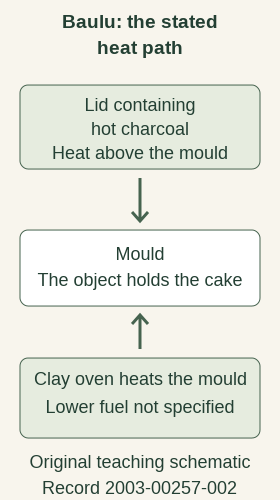
The diagram is a guide to the description, rather than a measured reconstruction of the object. For using equipment in a kitchen, a museum description is not a complete set of operating directions. Use an appropriate complete recipe and equipment instructions for that separate task.
Read the material and uncertainty exactly
The angku record has a material field: “Wood.” Its description says the object was “probably used” in making ang ku kueh. Preserve that qualification when writing about this particular object. “The museum identifies a wooden mould probably associated with making ang ku kueh” is more accurate than claiming a documented maker used it for a named ceremony.
The baulu record selected here does not display a material field. Its related-item links include an object labelled “Brass ‘kueh baulu’ mould with lid.” That is a separate record. A related item’s material cannot be copied into accession 2003-00257-002 without checking evidence for that object.
This matters when two things look similar or share a food name. Start with the accession you are actually describing. Attribute the stated material and function, and leave omitted information unconfirmed.
| Statement | Evidence in the selected records | Better wording |
|---|---|---|
| The angku object is wooden. | Explicit material field. | The Peranakan Museum record lists wood. |
| Someone certainly used this angku object for a named event. | The record only says probably used in making the cake. | Retain probably; the particular use is unconfirmed. |
| The selected baulu object is brass. | No material field; brass appears in a separate related-item title. | Material is not stated in this selected record. |
| The baulu lid contains hot charcoal. | Explicit description of the lid’s design. | Attribute the described heating arrangement to this record. |
On a phone, scroll inside the table. Keyboard users can focus the table region and use arrow keys.
An object period is not a food origin date
“1940s–1960s” and “Early 20th century” are the records’ year/period fields for the objects. They help a reader place the collected equipment in time. Neither field establishes when baulu or ang ku kueh was first made.
Likewise, an accession number identifies the museum record; it is not by itself the manufacturing date. The baulu record’s “Gift of Mr. David Ng” is a credit line. It identifies the gift credit, rather than proving that the donor made the mould.
Keep dimensions with their labels. The baulu record gives a diameter and height; the angku record gives height, width and length. You cannot compare the two displayed lengths as though both were the size of a cooked cake or the depth of a cavity. The selected records provide object measurements, not that additional measurement.
A useful classroom note is: “These are two collected objects with different period and dimension fields. To investigate a food’s origin, we would need sources about the food’s history.” That states what the comparison contributes and names the separate evidence needed for another question.
Keep the food explanation separate from the object
The angku object record describes red turtle cake as a Peranakan Chinese snack, with everyday and festive uses, including Chinese New Year. It explains red through auspicious cultural meaning. That describes a food context; it does not identify the exact occasion when this particular wooden object was used.
For colour and filling interpretations, use the ang ku kueh colour guide. It compares two dated cultural accounts and a named maker’s different system. There is no need to force the short museum description to answer every current ordering or ceremonial question.
For the broader category, the kueh/kuih name guide follows the Singapore inventory’s varied baked, steamed, sweet and savoury examples. The inventory also describes skills learned through households and other communities. It supplies cultural context, while the two object records supply the particular metadata compared here.
When making a display label, write the object identification first and the food context second. If you add a wider history or a host’s explanation of an occasion, identify its separate source. That lets another reader check each part without treating all the information as evidence about one object.
Check three museum-label interpretations
These are original fictional source-reading exercises. We did not handle, measure or use the museum objects.
Case 1
A student sees a related link labelled brass baulu mould and adds brass to accession 2003-00257-002. Is that supported by the selected record?
Show answer and explanation for case 1
No. The selected record does not display a material field.
The related object has its own identification. Read its record separately before comparing materials; do not transfer a field between accessions.
Case 2
A label says ang ku kueh was invented in the early twentieth century because that is the mould’s period. What has been confused?
Show answer and explanation for case 2
The object’s period with the food’s origin.
The selected record dates a collected object. Establishing a food’s origin needs separate historical evidence.
Case 3
A caption states this wooden mould was definitely used for a particular New Year celebration. Does the angku record establish that event?
Show answer and explanation for case 3
No. It says probably used in making the cake and does not document that event.
Keep the record’s uncertainty, and separate its general food-context description from a particular object’s use.
Write an object note with checkable fields
Here is an original completed note: “Ang ku kueh mould, Peranakan Museum accession 2010-00829. The record lists wood, early twentieth century, and Singapore and British Malaya; dimensions H6.0 × W9.5 × L26.0cm. It says probably used in making ang ku kueh. The food-context description includes everyday and festive uses; a specific use of this object is not documented here.”
For the baulu example, retain accession 2003-00257-002 and its National Museum collection, then state the lid-and-clay-oven description. Keep the absent material field unconfirmed. The short note becomes more useful when it includes the accession and the exact level of certainty, rather than only the food name.
FESTIVE FOOD OBJECT NOTE
Object title and accession:
Museum or collection:
Period assigned to the object:
Region in the record:
Material, if stated:
Dimensions and their labels:
Stated function and qualifications:
Food context, kept separate:
Unknowns and next source needed:
Open the object note as plain text. Read another practical festival guide or browse the seasonal food hub when your next question concerns a dish or occasion rather than the object.
Sources and further reading
- National Museum of Singapore: Kueh baulu mould, 2003-00257-002Selected object record: period, dimensions and charcoal-lid/clay-oven description. No material field displayed.
- Peranakan Museum: Ang ku kueh mould, 2010-00829Selected wooden object: dimensions, period and probably-used qualification. Object period is not food origin evidence.
- National Heritage Board: Kueh, Singapore inventory ICH-085Category and attributed practitioner examples; included October 2019; page last updated 15 October 2020. Not a tested recipe or current product listing.