Practical guide
Lion Dance vs Dragon Dance: A Visual Identification Guide
Follow the body: a compact costume animated from inside points to a lion; a long continuous body supported on poles points to a dragon. Use the original diagram and observation record, then check the troupe’s own description for style and ritual details. Colour, music and a fixed headcount are weaker clues.
The quickest difference: compact costume or long body on poles
Start with the body rather than the noise or colour. A lion appears as a compact animal with its own head and body, animated by performers inside the costume. A dragon appears as one long body supported at several points by poles, with handlers moving it through formations. Follow the same body from its head toward its tail before choosing a label.
The National Heritage Board of Singapore describes dragon dance as performers wielding a dragon prop mounted on poles. It also describes a separate pearl prop that leads the dragon. [2] Its lion-dance entry distinguishes northern and southern traditions and their performance arrangements. [1] These documented examples help identify structure; they are not rules for every troupe worldwide.
If your view is blocked, write “uncertain” rather than filling in an unseen body. A close-up of a decorated head alone may not show the feature that settles the question.
Original diagram: look at the support, not the head alone
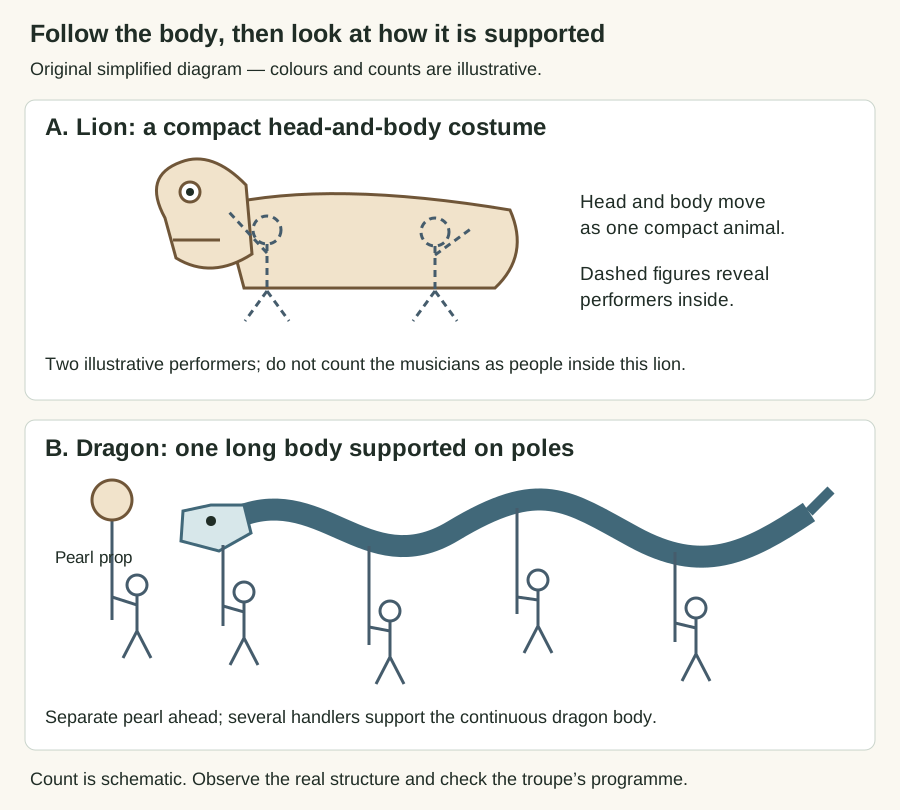
Download the original lion-versus-dragon diagram (SVG). Read the upper panel as one compact costume, then the lower panel as one continuous body with several support points. The separate pearl is a prop ahead of the dragon, not a second dragon head.
The sketch deliberately leaves out decorative details and difficult stunts. It is a spectator’s comparison of how the figures are supported, not instructions for holding a head, lifting a partner or operating a dragon.
A comparison you can use at a performance
| What to observe | Lion-dance clue | Dragon-dance clue |
|---|---|---|
| Body shape | A compact head and matching costume body. | One long, continuous body extending behind its head. |
| How it is supported | Performers animate the animal from inside the costume. | Visible handlers support parts of the body with poles. |
| Several figures at once | Several separate compact animals can be several lions. | Trace whether the visible segments belong to one continuous dragon. |
| Separate props | Greens or other props may form part of a particular routine. | A separate pearl may lead the dragon; verify the body too. |
| Movement | Watch how the head and compact body act together. | Watch how the long body bends through coordinated formations. |
| Colour, drums and setting | These alone do not establish the identification. | These alone do not establish the identification. |
Counting everyone on a stage gives you a troupe size, not necessarily the number operating one animal. Musicians, a pearl handler, assistants and performers in other figures can be present. First establish which people and supports belong to the body you are identifying.
Similarly, “there are many dancers” is not enough to call something dragon dance. A performance can include several lions. Three separate heads, each with its own short body, do not become one dragon because the group is large.
Why performer counts and regional styles need care
The Heritage Board’s lion entry describes northern lions with red-and-gold fur and a usual arrangement of two lions, each played by two performers. It also names the southern lion as xingshi, or “awakening lion.” [1] Do not turn that account into “every lion show has exactly two lions” or confuse two performers inside one lion with two animals.
A decorated head or fur can help you formulate a question about style, but ask for the troupe’s own name or programme description before assigning a regional label. A short video without context may omit part of the routine. Mixed programmes can also present lion and dragon dances at different times.
The dragon entry documents adaptations in Singapore, including luminous and lotus dragons and a competition using a seven-section dragon rather than the standard nine-section form described there. [2] This is why a fixed pole or section count is a poor universal test. The stronger clue is a long dragon body supported by multiple handlers.
That entry also describes differences between fire-dragon practices in China, Hong Kong and Singapore, including materials and ritual endings. “Fire dragon” is therefore not a complete explanation of one uniform custom. If a local programme uses that term, read its own explanation and follow the venue’s instructions; this guide does not describe how to make or perform such a prop.
Separate what you see from the ritual explanation
The lion entry describes dianjing, an eye-dotting ritual before a lion’s first performance, and caiqing, plucking greens associated with good fortune and prosperity. [1] Those are cultural meanings and beliefs, not promises of a financial result. Nor does seeing a brush or vegetables from a distance prove which ceremony you are watching.
The dragon entry describes preparing the dragon and pearl through a ritual and the dragon following the pearl during the dance. [2] Keep the visible object and the explanation in separate notes: “a round prop on a pole ahead of the dragon” is an observation; the ritual’s name and significance should come from a suitable local source.
You do not need to identify every ritual to enjoy a performance. A useful question afterward is “What is this routine called, and which tradition does your troupe practise?” Ask when appropriate rather than interrupting performers. Preserve the exact local name when it is supplied, instead of replacing it with a broad label that loses the distinction.
Use an eight-field observation record
Download the spectator observation record (TXT). It gives you eight prompts for the body, support method, separate animals, props, movement, appearance, identification and locally confirmed name. It also keeps direct observations apart from an organiser’s explanation and unknown details.
For a first visit, record only a few clear features. A useful fictional note is: “Three compact figures, each with a separate head and body; likely three lions. Style and number of performers inside are unconfirmed.” That is more informative than “a six-person dragon” inferred from people near the figures.
Record the actual event, place, year and performance time from its organiser or venue. Both dances occur at celebrations beyond Lunar New Year, and an event may schedule them on a weekend different from the festival date. A calendar date alone does not confirm a booking, route or performance time.
Observe from the permitted audience area and respect barriers and photography directions. Do not touch a prop or enter the performance space to count poles. If the necessary feature remains hidden, retain the uncertainty and check the programme afterward.
Four cases: identify the body or keep the uncertainty
These original fictional cases test the reason for an identification. They do not describe an actual event.
Case 1
You see three separate compact animals, each with its own head and matching short body. Many musicians stand nearby. Does the large total group make this one dragon?
Show answer and explanation for case 1
No. The visible structure suggests several lions, not one continuous dragon.
Count separate animals and follow their bodies. The musicians do not turn several compact costumes into a long pole-supported body; regional style and exact costume staffing remain unconfirmed.
Case 2
A long continuous body is lifted at several points by visible poles. A separate round prop moves ahead of its head. Which identification has the stronger support?
Show answer and explanation for case 2
Dragon dance, because of the continuous pole-supported body.
The separate pearl is an additional clue consistent with the Heritage Board account. The body and support method supply the main reason; this does not establish a universal section count or local ritual name.
Case 3
A close-up shows a brightly coloured head and loud drums. The rest of the figure is outside the frame. Can you confidently label the dance?
Show answer and explanation for case 3
Keep the identification uncertain until you can see the body or confirm the programme.
Colour, a decorated head and music alone do not show whether this is a compact lion costume or a long dragon body. Do not invent the unseen structure.
Case 4
You identify a pole-supported dragon but count fewer sections than the nine-section form described in one source. Must it be mislabelled?
Show answer and explanation for case 4
No. Section counts can vary; check the specific troupe or programme.
The Heritage Board documents a seven-section competition adaptation. A difference from one described form is not proof that the continuous dragon body has become a lion.
Sources and further reading
- National Heritage Board, Singapore: Lion DanceInventory entry describes northern and southern lion traditions, the northern two-lion/two-performers-each example, eye-dotting and plucking-greens practices. These are documented cultural examples, not universal troupe counts or promises of good fortune.
- National Heritage Board, Singapore: Dragon DanceInventory entry describes the pole-supported dragon and separate pearl, Singapore adaptations, seven-versus-nine-section competition variation and locally differing fire-dragon practices. Section and troupe counts are contextual; our schematic is independent.