Practical guide
What Is a Qilin Dance Head Made Of?
The Singapore heritage account describes a bamboo frame, paper layers and paste, a painted surface, and separate eyes and decorations. Read those as different craft layers: a modern eye material does not by itself change the prop’s cultural identity.
On this page
A head has structure, skin and finishing details
The July 2023 National Heritage Board essay describes making a qilin prop as a craft involving several materials and stages. The head is not simply carved from one block or made entirely from its visible decoration. A bamboo frame supplies the shape, paper covers it, and painting and attached details finish the object.
That distinction helps when looking at a photograph or museum display. A smooth painted horn tells you about the covered surface, but not every joint beneath it. A bell or artificial eye is an added detail, not evidence of the material used for the whole frame.
This guide explains the craft as documented in that account. It does not supply bamboo grades, paste proportions, attachment specifications, electrical directions or a load-bearing plan for a wearable prop.
Sources: [1]
The five stages in the documented account
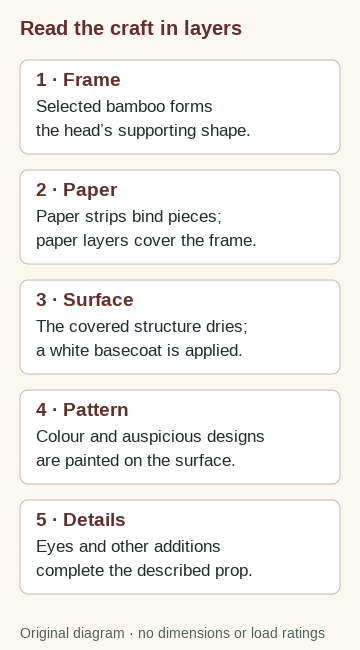
On a phone, swipe inside the table. Keyboard users can focus it and use the arrow keys.
| Stage | What the source describes | What the description does not settle |
|---|---|---|
| Frame | Selected bamboo rather than rattan, chosen for pliability, strength and stability. | Exact material grade, joint strength or the weight suitable for a dancer. |
| Binding and covering | Numerous bamboo pieces bound with paper strips; layers of paper glued using a homemade paste. | A reproducible paste recipe or attachment method. |
| Drying and basecoat | After the covered structure dries, a white basecoat is painted on. | A universal drying time or a specified coating product. |
| Patterns | Bright designs and smooth curved features, with auspicious imagery. | One compulsory colour scheme for every lineage or maker. |
| Added details | Eyes, bells, pom-poms and fur appear in the described finishing process. | Whether a particular displayed or modern prop uses every listed material. |
Sources: [1]
Why the frame and its weight matter
The essay connects carefully selected bamboo with a stable head frame. It also notes that the frame’s weight affects the dancer’s movements. Those are functional considerations behind an object that may first look purely decorative.
Do not reverse that observation into “lighter is always better” or an unsupported safe weight. A finished prop’s suitability also depends on its actual construction and the performer using it. The source offers no calculation that would let a reader approve an uninspected head.
For a cultural description, say what is known: “The documented craft uses a bamboo framework under a paper covering.” If the frame is hidden in your photograph, attribute that construction to the account rather than claim you personally inspected it.
Sources: [1]
Changing eye materials are part of the account
One particularly memorable change is the eyes. The essay describes hollowed duck eggshells in the traditional account, with table-tennis balls used instead because eggshells are fragile. It also mentions light bulbs that can be illuminated as another possibility.
These are described alternatives, not a checklist of required parts. A prop with table-tennis-ball eyes is not thereby a fake historical object; equally, a photograph of rounded white eyes does not prove their material. Ask the maker or read the object record if the distinction matters.
The account explains a material substitution within a living craft. It does not give electrical wiring or installation instructions, and it should not be presented as evidence that a particular illuminated head is safe or currently used by a named troupe.
Sources: [1]
Painted meaning differs from physical construction
The source lists motifs such as bamboo, chrysanthemum, plum blossoms and bottle gourd, relating them to the qilin’s benevolent character. It also describes five-coloured scales in terms of five directions and associated beliefs.
Keep those interpretations separate from material roles. A painted symbol can express a wish or cultural association; it is not a structural reinforcement or a verified protective effect. “The account associates the five colours with five directions” is a useful explanation. A promise of protection or a claim about a specific undocumented pattern would go further than the evidence.
To understand the performance rather than the object’s layers, use the separate qilin-versus-lion guide. The craft description alone does not identify which choreography, lineage or event the finished head belongs to.
Sources: [1]
Three craft-reading questions
These original fictional examples test the distinction between a material, a surface and a claim.
Case 1
A label states “bamboo frame, paper-covered.” Does a painted horn prove the entire head is carved wood?
Show answer and explanation for case 1
No. The label describes a framework and covering; the visible finish does not establish carved wood.
Shape and surface appearance cannot replace the documented construction materials.
Case 2
A maker identifies table-tennis balls as the eyes. Must the prop be rejected because an older account mentions duck eggshells?
Show answer and explanation for case 2
No. The source itself describes the substitution.
Modern material changes can occur within the documented craft. That fact does not authenticate every uninspected object.
Case 3
A five-colour scale pattern is explained as representing five directions. Does that establish a safe working weight?
Show answer and explanation for case 3
No. Symbolic meaning supplies no weight or strength rating.
The source connects frame weight with movement but gives no numerical approval criteria.
Sources and further reading
- National Heritage Board: High Leaps and Clashing CymbalsAngela Sim, MUSE SG Volume 16 Issue 2, July 2023. Hakka qilin dance in Singapore, the named Yang Zhen Wu lineage, percussion and a descriptive account of prop-making. This is not a current troupe calendar or construction specification.