Practical guide
Why the Chinese Calendar Repeats a Lunar Month
The HKO 2025 table starts month 6 on 25 June and again on 25 July. Keep the ordinary and extra blocks distinct, read their actual lengths, and avoid letting a calendar row decide a birthday custom.
Identify the repeated month before correcting it
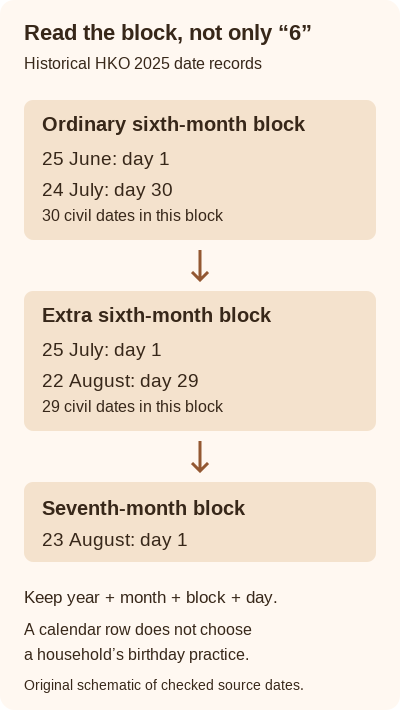
In HKO’s historical 2025 conversion table, “6th Lunar Month” appears on 25 June and again on 25 July. The next “7th Lunar Month” starts on 23 August. The second sixth-month block is an extra, or intercalary, month, often called a leap lunar month. It is not an accidental extra day in June or a reason to rename the second block month 7.
The Chinese calendar combines lunar months with the solar year. HKO’s introduction explains that 12 mean synodic months are shorter than a tropical year, so intercalation is needed. That background explains the purpose of an extra month; it does not provide a complete rule for calculating which month will be intercalary in any future year. [1]
Use the actual year’s table for the date you need. 2025 is used here as a clearly dated historical reading example. Our current converter covers 2026–2027 and cannot supply a 2025 lookup.
Read two sixth-month blocks without losing their boundaries
On a small screen, swipe inside the table, or focus it and use the arrow keys.
| Gregorian date | HKO lunar entry | Block in this sequence | Reading result |
|---|---|---|---|
| 25 June 2025 | 6th Lunar Month | Ordinary sixth-month block | Day 1 |
| 24 July 2025 | 30 | Ordinary sixth-month block | Last day before the next start |
| 25 July 2025 | 6th Lunar Month | Extra sixth-month block | Another day 1; preserve which block |
| 22 August 2025 | 29 | Extra sixth-month block | Last day before month 7 |
| 23 August 2025 | 7th Lunar Month | Seventh-month block | Day 1 of month 7 |
Read the whole sequence, including the row before and after a reset. The ordinary block runs from 25 June through 24 July: 30 civil dates. The extra block runs from 25 July through 22 August: 29 civil dates. Subtracting the two successive start dates gives those lengths. [2]
The official English text and one-page PDF both print “6th Lunar Month” twice. Their adopted rows do not spell out an English “leap” field. Preserve the ordinary/extra distinction in your own record rather than pretending that every exported label includes it. This page’s block labels explain the checked sequence. [3]
Keep the extra-month field in a date record
“2025, lunar month 6, day 5” leaves a material distinction out of this example. In the ordinary block, day 5 is 29 June; in the extra block, day 5 is 29 July. Both rows use the same month number and day number. The block determines which Gregorian date you mean. [2]
A complete reading note can say: “HKO 2025, extra sixth-month block, day 5; Gregorian date 29 July 2025; block starts 25 July.” If the original note only says “sixth month, fifth day,” leave the block unresolved until the original record or person supplying it clarifies the meaning.
Do not assume a spreadsheet, app or copied caption retains this distinction. Inspect the supplied fields. When a record explicitly supplies an intercalary-month flag, keep it with the month and day; when it does not, retain the uncertainty rather than inventing a flag. No calendar application was tested for this article.
A calendar record does not select a birthday arrangement
Finding a date and choosing a celebration are separate tasks. A household may have its own arrangement when a lunar date occurs in an extra month. The astronomical table cannot establish whether that household celebrates once, twice, in the ordinary month or on another agreed date.
For a birthday invitation, ask the person or household what date they want to use. Preserve their stated arrangement beside the source-labelled calendar date. An unresolved celebration rule can remain unresolved even when both calendar blocks have been read correctly.
Use the existing birthday guide for collecting the remembered Gregorian and lunar inputs. The month-length guide explains what to do when a requested lunar day 30 does not exist in a particular block.
Work through three reading checks
These are original exercises using the checked source sequence. They are not reader case reports or evidence of a household custom. Download the original repeated-month note if it helps retain the fields.
Case 1
The 2025 table starts month 6 on 25 July, then month 7 on 23 August. Should 25 July be renamed month 7?
Show answer and explanation for case 1
No. Keep it as the extra sixth-month block.
The actual source supplies another sixth-month start. Renaming it would lose the distinction and contradict the subsequent seventh-month reset.
Case 2
A note says only “2025 month 6 day 5.” Can you choose 29 July from that wording alone?
Show answer and explanation for case 2
No. The ordinary or extra block is still missing.
The checked ordinary block gives 29 June; the extra block gives 29 July. Preserve the missing field and ask the source of the note.
Case 3
Both source dates have been identified. Has the table decided which birthday a family must celebrate?
Show answer and explanation for case 3
No. Confirm the household’s own arrangement.
The record establishes calendar dates, not an obligation or universal family practice.
Sources and further reading
- Hong Kong Observatory: The Chinese Agricultural CalendarNew-Moon month start, mean synodic month and intercalation background. This is an introduction, not a complete modern calendar-construction algorithm.
- HKO: 2025 Gregorian–Lunar daily text tableActual June–August month-start, last-day and day 5 rows. Historical 2025 example; English entries repeat the sixth-month number.
- HKO: 2025 one-page conversion table (PDF)Visual comparison of the June, July and August rows and first-day legend. The adopted English labels do not print an explicit leap-word field.