Practice worksheet
Checking a Chinatown New Year Event Listing: Date, Route and Organizer
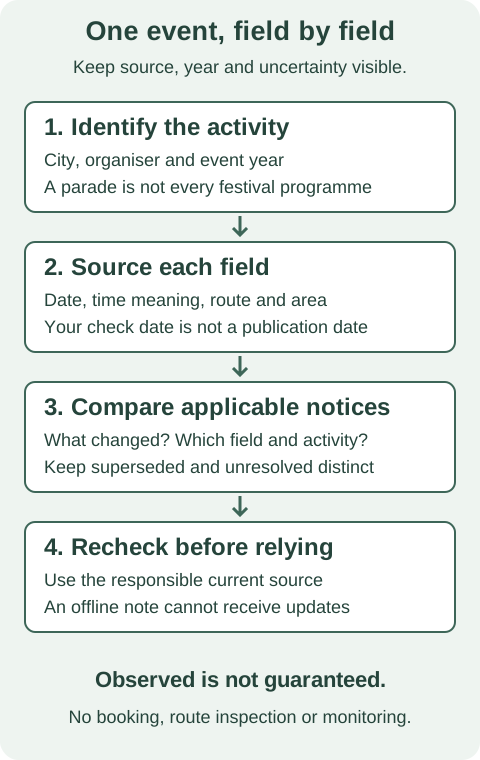
Check one event field by field. Keep activity, year, source and time meaning together, distinguish changed notices from cancellation and uncertainty, and recheck before the decision that depends on the information.
Check one activity and year before copying the listing
To check a Chinatown New Year event listing, identify the exact activity, city, organiser and event year, then attach a source to each practical detail. Confirm whether a time means the start, arrival or check-in, and look for a later notice that changes the same activity. A familiar logo, an old photograph and an undated search snippet do not complete that check.
A festival can include a parade, a market, performances and separately ticketed viewing. “The festival is on Saturday” is too broad when you want one specific programme. Begin with a sentence such as “I am checking the named parade in this city for 2027,” rather than a collection of appealing search results.
This original record is a way to organise evidence. It does not book tickets, inspect a route, verify personal access, contact an organiser or monitor future changes. A checked future announcement can still be superseded. Keep the date you checked it beside the fields you intend to use.
The calendar-versus-parade date comparison explains why the two dates can differ. The spectator etiquette guide covers viewing and interaction. Here the narrower task is auditing the listing and replacing changed information without silently mixing sources.
Establish the source and the year of the particular notice
Open the actual page. Identify the organisation presenting the event, its stated role and the route from its event page to practical instructions. A reposting account can be useful for discovery but does not automatically control the date, route, admission or cancellation.
Check the year inside the specific announcement. A site can contain a current event notice, older sponsor stories and historical videos at the same time. The site's current footer year or the date of a neighbouring article is not the year of every item on it. An authentic old poster should remain an old poster in your notes.
The San Francisco Chinese New Year Festival & Parade homepage provides a concrete example. In the source checked on 2026-11-01 (UTC), the event announcement names 20 February 2027 and the Year of the Ram, while the page also includes 2026 stories and a 2025 video mention. Its contact section identifies the Chinese Chamber of Commerce of San Francisco as organiser. [1] Those older items do not invalidate the new notice; they require item-level reading.
Keep the organiser's supplied event name and year label when quoting the notice. Do not use a zodiac label alone to decide which event a search result describes. For a calendar explanation, use the relevant annual table. HKO's 2027 table labels the year Ding-wei and the Goat, and its February rows identify the first lunar month separately. [3] That calendar source does not confirm a public parade route, ticket or cancellation.
Attach evidence and scope to each practical field
Use an evidence register instead of giving the entire listing one “verified” tick. Each row needs the relevant event year, source and meaning. The example below records what the San Francisco organiser's pages stated when checked on 2026-11-01 (UTC). It is a future-announcement example to recheck, not an attendance instruction for every Chinatown.
| Field | Observed statement | Source | Limit to retain |
|---|---|---|---|
| Activity and year | Chinese New Year Parade, 20 February 2027. | Organiser homepage and FAQ. | Separate from neighbouring historical stories or other festival activities. |
| Start time and place | FAQ: 5:15 PM, starting at 2nd and Market Streets. | Organiser FAQ. | The stated start is not every visitor’s arrival or ticket check-in time. No timezone abbreviation is supplied in this quoted field. |
| Route description | FAQ describes travel around Union Square and an end at Kearny Street and Columbus Avenue. | Organiser FAQ text. | Text has been read; the route has not been inspected, and a later map or notice may change it. |
| Attendance and seating | General attendance is free; bleacher sections require tickets. | Organiser FAQ. | A seating rule concerns that area, not every associated programme or a confirmed purchase. |
| Weather statement | FAQ says the parade will not be cancelled if it rains. | Organiser FAQ. | This statement is not a guarantee against every future disruption or a live weather assessment. |
Keep the exact kind of time beside its value. A start time, an admission opening, a reserved-section check-in and a performance slot answer different questions. Do not replace an earlier arrival instruction with a later parade-start time because the latter is easier to remember.
Follow the official event page to ticket information when relevant. The checked FAQ identifies its stated ticketing route and cautions about unofficial sellers. [2] This article has not verified a checkout, purchased anything or established refund terms for your transaction. Consult the actual current provider and the named activity before relying on those details.
For access, record the needed feature and the source that confirms it. A general statement about accessible viewing is not confirmation of your entrance, approach, toilet or reserved location. Ask the appropriate organiser or venue about the specific requirement, and leave it unresolved until the answer is available.
Resolve conflicts by the affected field and responsible source
If two notices disagree, retain both rather than quietly selecting the date or route that suits your trip. Record the activity, year, publication or update date if supplied, and exactly which field conflicts. A publication date can help sequence notices, but a newer page about a different activity does not supersede the one you need.
Ask which source is responsible for the field. The event organiser can clarify the programme or viewing arrangement; the transport operator controls its service information; the actual venue can answer its entrance question. A reliable calendar table answers the traditional date. No one page automatically supplies all of those answers.
An original question draft is: “I am checking [activity, city and year]. Your [page] states [value], while [other notice] states [other value]. Which is current for [specific field], and is there an updated notice I should use?” Keep private ticket, identity and contact details out of a public comparison. This draft is not a message already sent.
A failed page load, missing heading or unavailable map leaves information unconfirmed. It is not proof that the event has been cancelled. Conversely, a cached older page is not proof that a later route change did not happen. Record the limit of the actual check and seek the relevant current source when the missing detail matters.
Distinguish a changed plan, cancellation and unresolved information
A notice needs the same identity checks as the original listing. Find the activity and year it covers, who issued it, its effective information and the exact change. A cancelled stage performance does not by itself cancel a parade; a relocated viewing area does not necessarily change the calendar day.
| Outcome | What the notice establishes | Record action |
|---|---|---|
| Changed arrangement | A responsible source supplies a replacement date, time, route, entrance or area for the named activity. | Retain the old value as superseded, state the replacement and update only the affected plans. |
| Cancellation | A responsible source explicitly cancels the named activity or relevant booking. | Record the exact scope; check separate provider and transport arrangements without assuming automatic cancellation. |
| Unresolved information | The page is missing, two applicable notices conflict, or the needed detail is not supplied. | Keep it unresolved and ask the appropriate source. Do not invent either continuation or cancellation. |
The checked San Francisco FAQ's rain statement is useful context, but it does not establish that no later notice can ever change the event. Do not turn “rain does not cancel this parade” into a rule for another city's programme or a reason to disregard local conditions and actual staff directions.
When sharing a correction with companions, include the full activity, year, changed field and source. A draft might say: “For [exact event/year], [source] has changed [field] from [old] to [new]. The earlier [field] should no longer be used. [Other detail] remains unconfirmed.” This records the change without claiming all recipients read it or every other arrangement is unchanged.
Keep a workable next step when the update makes the outing unsuitable: a different confirmed arrangement, postponing the decision or not attending. A completed record cannot restore a missing access feature or guarantee the advertised programme.
Make a recheck plan for your own outing
Choose the decision that depends on the information: asking for a place, buying a ticket, arranging transport or leaving for the event. Identify the essential fields and recheck the relevant source before that decision. The useful timing depends on the actual announcement and your commitments; this page prescribes no universal “24 hours before” rule.
Keep the latest source link available as well as an offline note if useful. An offline screenshot can help you remember a source, but cannot receive an update. If you save a map, retain the activity, year, version or notice date when provided, and do not mix it with an old poster's date.
Separate programme confirmation from the rest of your trip. Check actual service changes, travel connections, venue rules and the return arrangement with the responsible providers. Use the wider calendar travel checklist for these different dependencies; the present register audits the specific Chinatown listing.
For the cultural context and a comfortable visit, return to the Chinatown celebration guide. A source-backed schedule does not identify every dance, describe every community's custom or assess an individual visit. Keep the organiser's stated name and the actual place visible.
Seven checks on a listing conclusion
These original fictional cases test the evidence record. They are not reports of cancelled or changed real events.
Case 1
The homepage has a 2027 parade notice and a 2025 video mention. Must every item on it describe 2027?
Show answer and explanation for case 1
No. Identify the year of each particular item.
A current event announcement and historical stories can coexist. Neighbouring content does not silently change a notice’s year.
Case 2
The FAQ states a parade-start time. Does that replace a ticketed-section check-in instruction?
Show answer and explanation for case 2
No. Keep start, arrival and check-in meanings separate.
They answer different questions even when they concern the same event.
Case 3
A reliable annual calendar provides New Year’s date. Does that confirm a city’s parade entrance?
Show answer and explanation for case 3
No. Use the actual event or venue source for the entrance.
Calendar evidence cannot supply event logistics.
Case 4
A new notice cancels one stage performance. Is the whole festival automatically cancelled?
Show answer and explanation for case 4
No. Read the named activity and cancellation scope.
Separate programmes or bookings need their own applicable information.
Case 5
The organiser’s map fails to load. Does this prove cancellation?
Show answer and explanation for case 5
No. Keep the route information unresolved.
A failed access attempt does not establish an event outcome.
Case 6
A FAQ says the parade is not cancelled by rain. Does it prove no later disruption can change it?
Show answer and explanation for case 6
No. Recheck applicable current notices and conditions.
The statement has an event-specific scope and is not a guarantee against every future change.
Case 7
An updated entrance conflicts with the old saved map. Should the old value stay in the active plan without a note?
Show answer and explanation for case 7
No. Identify the applicable current instruction and mark any replaced field as superseded.
Retain the source trail and resolve a genuine conflict; do not silently combine incompatible versions.
Copy the listing record and keep updates identifiable
CHINATOWN NEW YEAR — LISTING EVIDENCE RECORD
Exact activity / city / organiser / event year:
Official event page / how the organiser identity was established:
Full event date / local time as stated / timezone if supplied:
Start, arrival, check-in or performance time: which one is this?
Route, entrance or viewing area: which activity does it belong to?
Ticket or reservation rule / specific area / official entry source:
Required access feature / confirmation still needed:
Source publication/update date, if actually supplied:
My check date and timezone:
Latest relevant notice located / event year and activity it covers:
Changed field / previous value / replacement / effective notice:
Conflicting source / question / appropriate contact:
Field state: observed announcement, superseded, or unresolved:
Next recheck before commitment or travel:
An observation of a future announcement is not a guarantee.
Open the listing record, notice states and seven explained checks (TXT). Copy only the fields you need and keep unknowns visible. This page does not store or assess your entries.
A concise source note for the real example is: “San Francisco organiser homepage and FAQ checked 2026-11-01 (UTC) announce the 2027 parade and provide the stated start, route and seating information. These future arrangements require a later recheck before relying on them.” The note does not assert that a map was inspected, a seat booked or a later change ruled out.
Keep source observation, confirmation from a responsible person and your actual booking separate. If a notice changes, mark the affected earlier field as superseded rather than deleting its history. When a required field remains unresolved, the honest result of the audit can be “not enough information to make this plan yet.”
Sources and further reading
- San Francisco Chinese New Year Festival & Parade: organiser homepage2027 parade notice, organiser identity and coexistence of dated historical stories. No promotional ranking or third-party claim adopted.
- San Francisco Chinese New Year Festival & Parade: FAQStated 2027 start, route text, viewing and seating distinctions, rain statement and ticketing route. Recheck future arrangements; no route or checkout inspected.
- Hong Kong Observatory: 2027 Gregorian–Lunar Calendar Conversion TableAnnual calendar header and February context. Calendar conversion does not establish public-event logistics.
Save the year you actually checked
For a traditional festival note, inspect a separately dated annual festival event. Repeating a Gregorian month and day does not perform a lunar-calendar conversion or verify a future community programme.