Practical guide
Lunar New Year Parade Etiquette for First-Time Visitors
Watch from permitted space, keep crossings clear and respect people and performers. A checked San Francisco example shows why a rule's event and viewing-area scope matter; original courtesy cards, three tables and six cases help you prepare.
Begin with this event's rules, then use ordinary courtesy
For a first Lunar New Year parade, stay in the permitted spectator area, keep crossings clear and follow staff directions. Take photographs without obstructing other people or interrupting performers. Ask before a posed close photograph or an unfamiliar interaction, and accept a refusal without pressure.
Start with the actual organiser's current instructions for the named event and year. “Lunar New Year parade” describes many programmes; it does not identify one set of tickets, photography restrictions or cultural practices. A community celebration, a shop-front lion dance and a ticketed viewing section can have different arrangements.
This guide combines a checked organiser example with original courtesy suggestions. The San Francisco organiser's homepage and FAQ were read on 31 October 2026. Their announced 2027 arrangements are an example to recheck before travel, not rules for every parade or a guarantee that later notices will stay unchanged.
The suggestions about asking for a portrait and leaving a performer space are practical courtesy. They are not a statement that every public photograph requires legal consent, or that a ticket grants permission to enter the route, handle a prop or participate in a ritual.
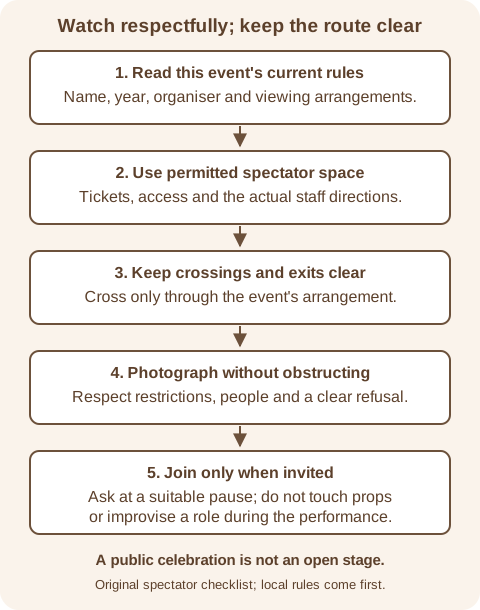
Check the viewing area and the equipment you want to bring
Open the current official event page rather than relying on a photograph or an undated repost. Tie each rule to the area it actually covers. A request for ticketed bleachers should not silently become a restriction everywhere in the surrounding city.
| Question | Information to find | Why scope matters | If unclear |
|---|---|---|---|
| Where may I watch? | Permitted spectator space, barriers and restricted areas. | Public attendance does not open the moving route. | Ask the event steward before choosing a position. |
| Does this space need a ticket? | Specific section, check-in and entry instructions. | Free general viewing and reserved seating can coexist. | Check the exact area; do not infer access from a receipt. |
| Where may I cross? | Designated points and staff control. | A crossing is not a spare viewing position. | Follow the current on-site arrangement. |
| What items are restricted? | Camera equipment, bulky items and applicable area limits. | A bleacher request is not automatically an event-wide ban. | Ask the organiser about the particular item and area. |
| What access do I need? | Current step-free viewing, seating, approach and toilet details. | An outdoor route is not automatically suitable for every visitor. | Confirm the relevant features and arrangement. |
| What photography limits apply? | Event, venue or activity-specific instructions. | One permitted photograph does not grant every kind of access. | Observe first and ask at a suitable pause. |
| What could change today? | Current update channel, route changes and departure information. | An earlier FAQ may be superseded by a later notice. | Use official updates and actual staff directions. |
In the checked San Francisco FAQ, general attendance is free while bleacher seating is ticketed. The organiser asks that oversized items, selfie sticks and camera tripods, among other listed items, not be brought into the bleacher sections because they can encroach on others' space. Keep that stated area and wording visible; it is not a blanket claim that cameras are forbidden along the entire route.
The same FAQ describes reserved accessible viewing and specific accessible bleacher-ticket arrangements. Those details belong to that event. Reconfirm the actual viewing location, entry and approach you need; this article has not checked a visitor's route or reserved a place.
Keep crossings, exits and the moving performance clear
A gap in the crowd is not necessarily a place to stand. It may be a controlled crossing, an emergency route, an entrance or space the performers need. Choose a permitted view that does not obstruct movement, and move when the responsible staff ask.
The San Francisco FAQ says spectators may watch behind the barricades. It identifies crossing points, asks visitors not to stand there to watch, and says those areas must remain clear for emergency personnel. It also says law enforcement and parade personnel will instruct guests when crossing is safe. This is an explicit organiser example, not a self-directed permission to cross whenever a float seems far away.
Keep yourself, bags and camera equipment out of the active route. Do not step into a dance to obtain a close-up, follow a moving prop through a barrier or create a new gap by pushing other viewers. If the view is blocked, use another permitted position or enjoy what you can see; a complete photograph is not an entitlement.
Agree a companion meeting point and an early-exit arrangement outside restricted or obstructive space. A “quiet spot” is useful only if it actually exists, can be reached and is permitted. For a crowd or immediate safety concern, follow the actual staff and local help instructions; this checklist supplies no crowd-control or emergency protocol.
Take photographs without obstructing or pressuring people
First check whether the organiser, venue or particular activity has photography instructions. If a restriction or request is made, follow it. Do not treat being outdoors, having paid for a seat or seeing someone else's camera as permission for every photograph.
| Situation | Courteous approach | Avoid |
|---|---|---|
| Wide view from a permitted area | Keep your camera within your space and preserve others' view and movement. | Holding equipment across a crossing or leaning into the route. |
| Posed portrait of an individual | Ask briefly when appropriate; accept no or uncertainty. | Following, repeated requests or assuming a smile is agreement. |
| Close photograph involving a child | Use the appropriate parent/guardian and event arrangement, and respect the child too. | Pressuring a child to pose or publishing identifying details casually. |
| Moving performer or routine | Photograph only within the event's actual directions and your permitted position. | Calling for a pose or stepping into the routine. |
| Flash or bulky equipment | Check activity and area instructions and choose a considerate setup. | Assuming a tripod, selfie stick or flash is acceptable everywhere. |
| Sharing a photograph afterward | Keep context accurate and consider the people and private information shown. | Inventing a ritual name, exposing personal details or ignoring a request not to share. |
An original portrait question is “May I take your photograph?” If the answer is no, the person turns away or the situation is unclear, leave it. An invitation to pose should be voluntary; you do not need to obtain the photograph to finish the visit.
For children, use the relevant parent, guardian and event procedure rather than a blanket assumption based on a public setting. Avoid attaching unnecessary names, school details or locations to a close image when sharing. These are courtesy and privacy suggestions, not a complete account of photography law in every jurisdiction.
Check that the caption says what you actually know. A lion or dragon image does not establish a particular ritual, troupe style, event date or the cultural identity of every person in the frame. Use the separate identification and naming guides below for those questions.
Ask before touching a prop or joining a custom
A lively or playful performance can invite a response, but it does not make every action appropriate. Do not reach into a costume, handle a pole or take an object because a photograph online showed a similar interaction. Wait for the performers' or hosts' actual invitation and instruction.
Singapore's National Heritage Board describes lion-dance practices including eye-dotting and plucking greens, with cultural associations of good fortune. Its dragon-dance entry describes the dragon and separate pearl props and variations in local practice. These accounts explain particular traditions; they do not designate every spectator as a ritual participant or promise wealth from touching a prop.
| What you encounter | Useful question or choice | Assumption to avoid |
|---|---|---|
| An unfamiliar ritual begins | Observe and read the host's explanation; ask at an appropriate pause. | Every brush, vegetable or envelope identifies the same ritual. |
| A performer approaches viewers | Follow the actual invitation and directions; decline if you prefer. | An approach authorises grabbing the costume or prop. |
| An offering, envelope or donation appears | Ask the host how this activity works and whether taking part is optional. | A household hongbao custom is the required procedure at every parade. |
| A prop moves close to the barrier | Keep the performance space and your position clear. | A prop within reach is there for you to handle. |
| A named custom remains uncertain | Record the supplied name or leave it unconfirmed. | Inventing a local label or promising an auspicious outcome. |
A simple question is “Is participation invited, and what should I do?” An organiser may direct you to watch, wait or ask a particular host. If the answer is unclear, observing is enough. Do not interrupt a moving routine to get a cultural explanation or demonstrate a role you have not been invited to perform.
An envelope exchange, a troupe offering and a family gift are different settings. The appearance of a red packet alone cannot tell you the amount, recipient, expected action or purpose. This guide sets no required payment or donation and does not arrange one.
Four fictional spectator decisions
These invented situations illustrate the choices. They are not reports of visits or statements that every parade uses the same rules.
1. A clear crossing looks like the best camera angle
Rae notices an open gap with a view of approaching floats, but it is a designated crossing.
Better choice: Use permitted spectator space and keep the crossing clear. Cross only through the actual staff-controlled arrangement.
A good angle does not change the purpose of the space.
2. A bleacher visitor brings a tripod
Ben has read the checked San Francisco FAQ but assumes its equipment request applies only to other visitors.
Better choice: Follow the organiser's stated bleacher request and choose an acceptable setup. Do not turn that request into a claim that every camera everywhere is banned.
The rule's scope matters both when complying with it and when explaining it.
3. A child does not want a portrait
Alex asks for a close photograph, but the child turns away and the accompanying adult declines.
Better choice: Thank them and leave the photograph. A public celebration does not make posing obligatory.
Repeated asking or following would turn a voluntary interaction into pressure.
4. A spectator copies a ritual from a video
Lin sees greens and a lion costume, then reaches forward because an online clip showed a spectator doing so.
Better choice: Observe from the permitted place and follow this troupe's actual invitation. Ask about the routine at a suitable pause rather than grabbing an object.
A similar object or video does not establish a local role or promised good fortune.
Copy the viewing record and courteous question card
Use the first record for event-specific facts and unresolved questions. The second gives short wording for asking staff or a host without needing a rehearsed cultural performance. Keep individual contact, ticket and personal information private.
PARADE VISIT — RULES AND VIEWING RECORD
Exact event / city / organiser / event year:
Current official instructions / checked date:
Viewing area / ticket or reservation arrangement:
Barrier, crossing and staff-direction rules:
Needed access, seating and toilet arrangements:
Camera, tripod, selfie-stick and other item limits:
Photography restriction or question still unresolved:
Arrival, group meeting and departure arrangements:
Quiet break / early exit / current update channel:
Keep this event's rules separate from other parades.
PARADE VISIT — COURTEOUS QUESTIONS
For a steward: Where may spectators stand here?
For crossing: Is this the designated crossing, and when may we cross?
For viewing access: Which arrangement applies to this area today?
For a portrait, when appropriate: May I take your photograph?
If the answer is no or unclear: Thank you; I will leave it.
For interaction: Is participation invited, and what should I do?
For an unfamiliar custom: What is this routine called?
Ask at an appropriate pause; do not interrupt a performance.
An answer about one activity is not permission for another.
Download both editable cards, three reference tables and six explained cases. The record does not reserve seating, inspect access or contact the organiser for you.
Case 1
A designated crossing has a clear view. May you stand there to watch because it is not crowded?
Show answer and explanation for case 1
No. Use permitted spectator space and keep the crossing clear.
The checked San Francisco FAQ explicitly keeps crossings clear for emergency personnel and uses staff-controlled crossing. Your actual event may have its own arrangement.
Case 2
The San Francisco FAQ asks that tripods not be brought into bleacher sections. Does that establish a universal camera ban at every Lunar New Year parade?
Show answer and explanation for case 2
No. Keep the stated item, area and organiser scope.
A request about encroaching items in one event's bleachers is different from a blanket prohibition on cameras everywhere. Read the rules for your actual viewing area.
Case 3
A performer is moving nearby and your view is blocked. Does a ticket allow you to step into the route for a close-up?
Show answer and explanation for case 3
No. A viewing ticket is not permission to enter the performance space.
Respect barriers and staff directions. Use another permitted view or leave the shot rather than interrupting the routine.
Case 4
A child and accompanying adult decline a posed photograph. Should you keep asking because the event is public?
Show answer and explanation for case 4
No. Accept the refusal and leave the photograph.
The courtesy suggestion keeps a posed interaction voluntary. It is not a claim that this page states all local photography law.
Case 5
You recognise greens beside a lion costume. Does that mean you may take the greens or that doing so will bring wealth?
Show answer and explanation for case 5
No. Follow the actual invitation and keep cultural belief separate from a promised outcome.
The heritage source describes particular practices and meanings. A familiar object does not give every spectator a role or establish a financial result.
Case 6
Last year's event photograph shows spectators touching a prop. Does it confirm this year's participation rules?
Show answer and explanation for case 6
No. Check the exact organiser, activity and current instructions.
An old image records a moment without all its context. It cannot confirm this event's access, permission or ritual arrangement.
Leave with useful context, then recheck the next visit
A worthwhile first visit can be a few performances enjoyed from a permitted place, one new local name and a comfortable finish. It does not require touching a costume, collecting an offering or producing a complete photograph of every routine.
Afterward, separate observations from explanations: “A round prop led a long body on poles” describes something visible; the troupe's supplied name gives cultural context. Keep an unresolved name uncertain rather than filling a caption with a familiar claim from another community.
For the next visit, check the current event year, official updates, viewing and travel arrangement again. One organiser's past route or a visitor's old image does not confirm the next event. Follow appropriate local warnings and staff instructions for a safety concern; an advertised programme is not a reason to remain in an unsafe situation.
Use the linked Chinatown visiting guide for the wider outing, the schedule comparison for dates, and the lion-versus-dragon guide for identification. Keep this article's task focused: how to watch, photograph and ask respectfully while preserving the actual host's rules and the people around you.
Sources and further reading
- San Francisco Chinese New Year Festival & Parade: FAQChecked 31 October 2026: behind-barricade viewing, controlled crossings kept clear for emergency personnel, free general attendance vs ticketed bleachers, accessible arrangements and bleacher equipment request. Specific announced 2027 event; no universal camera ban or law inferred.
- San Francisco Chinese New Year Festival & Parade: organiser homepageExact event name, 2027 announcement and Chinese Chamber of Commerce organiser identity. Third-party mentions and promotional superlatives excluded.
- National Heritage Board, Singapore: Lion DanceEye-dotting, plucking greens and cultural associations in the documented setting; no automatic spectator role or promised financial outcome.
- National Heritage Board, Singapore: Dragon DanceDragon and separate pearl props and locally differing practices; no permission to handle props or universal ritual instructions.