Practical guide
Chinese New Year Classroom Activity: Living Heritage in 20 Minutes
Use three attributed reading cards to explore what people do at Chinese New Year and how knowledge or skills are passed on. This editable 20-minute plan includes a worked record and explained answers.
On this page: six lesson steps
Set up a Chinese New Year source-reading activity
The useful question is: what do people do, and how do they learn the knowledge or skills involved? This gives learners something concrete to investigate without treating one classroom craft as a complete account of a festival. The lesson uses the Chinese Spring Festival entry in UNESCO’s living-heritage records. It does not represent every tradition described by the wider label Lunar New Year.
You need the three cards below, the blank record and a way to write or discuss answers. A teacher can read the cards aloud, learners can read in pairs, or a family can use one card together. Choose the approach according to actual reading needs. No special food, costume, photograph or personal family disclosure is required.
The cards and answers are original teaching materials based on the named public text. They are not UNESCO lesson plans or a report of a class that has been taught and measured. The goal is a source-supported explanation, not an authenticity score. For the recognition record itself, read what the 2024 UNESCO listing means.
Use this editable 20-minute plan
The times below add up to 20 minutes and serve as planning allocations. They are not measured completion times or a promise that every group will finish. If reading takes longer, use a single card and move the exit case to the next session. Keep the evidence record rather than rushing to add a craft.
| Minutes | Task | What learners produce |
|---|---|---|
| 0–3 | Name the occasion and the reading question. | One sentence: this lesson reads about Chinese Spring Festival practices and how people learn them. |
| 3–7 | Read the three source-summary cards below. | Mark a described action and any explicit transmission information. |
| 7–12 | Complete one source record. | A supported detail, a transmission route and an unresolved detail, with attribution. |
| 12–17 | Write a caption and compare it with a worked example. | A short description that separates the source from the classroom task. |
| 17–20 | Answer an exit case and revise one sentence. | A correction with a reason drawn from the source. |
On a phone, scroll inside the table to read every column. Keyboard users can focus this region and use the arrow keys.
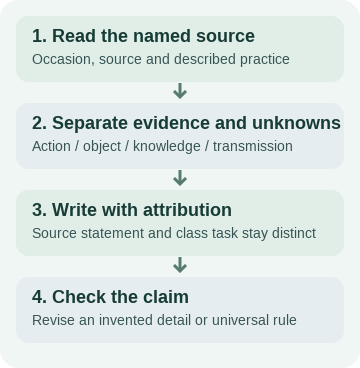
Begin by naming the source and occasion. Ask learners to choose a detail the text actually supplies. During the record stage, “not specified” is a valid answer when a card does not identify an object, teacher or household. In the caption stage, learners should mark which sentence reports the source and which describes their own classroom work.
Read three attributed source-summary cards
These cards paraphrase one public UNESCO entry, so they are three reading perspectives on one source, not three independent witnesses. Card A focuses on an action, Card B on participants and Card C on transmission. Keep that relationship visible when assessing an answer.
Card A · Preparation
Before the festival
UNESCO’s public Spring Festival entry describes cleaning homes, stocking provisions and preparing food in the days before the festival. The entry calls the larger process of celebration guonian, or “crossing the year.”
Reading task: underline one action. Does this short description identify a particular recipe, household or teacher? If it does not, leave that field unresolved.
Original classroom summary of UNESCO element No. 02126. The summary describes the entry’s scope; it is not a report about your class.
Card B · Gathering and greetings
People taking part
The same entry describes families dining together and staying up late on New Year’s Eve. During the festival, it describes greetings to elders, relatives, friends and neighbours, as well as other social and religious practices.
Reading task: identify the people explicitly mentioned. Does a description of a festival practice mean every person must perform it? Explain why your caption should leave room for different households.
Original classroom summary of UNESCO element No. 02126. This is a reading activity; it does not ask learners to enact a religious practice or disclose family customs.
Card C · Passing on knowledge and skills
How people learn
The entry describes knowledge of rituals, customs, legends and ballads, and skills for making festival decorations and supplies. It says these are transmitted informally within families and communities and formally through public education. Related crafts and performing arts are also transmitted through apprenticeships.
Reading task: circle the routes through which knowledge or skills are passed on. Keep a route, such as apprenticeship, separate from a named teacher. The source names the former, not a teacher for your class.
Original classroom summary of UNESCO element No. 02126. No apprenticeship, family interview or craft demonstration was observed for this lesson.
Read the original UNESCO Spring Festival description to check all three summaries and their limits.
UNESCO’s general explanation of intangible heritage emphasises living expressions and knowledge or skills transmitted between people. It also explains that heritage can evolve and depends on the communities that create, maintain and transmit it. Use that definition to ask a better question; do not use it to decide on behalf of a community which classroom activity belongs to its heritage.
Separate action, object and transmission in a worked record
Try the food-preparation detail from Card A. A dish or decoration is something you might see. The knowledge of making it, the practice of using it and the people through whom learning occurs are different fields. More than one category can be relevant, but each needs support. The worked record below deliberately keeps several details unresolved.
| Record field | Example answer | Why this answer fits |
|---|---|---|
| Described practice | Preparing festival food before the festival. | Card A describes this action; no particular dish is named. |
| Object or material | Not specified in this card. | Food preparation does not establish an ingredient list or a particular utensil. |
| Knowledge or skill | Festival knowledge and preparation skills appear in the wider entry. | Card C describes the general transmission context; it does not name a recipe lesson. |
| Transmission route | Family/community learning or public education are stated at entry level. | This is a general source statement, not evidence that a named person taught this action. |
| Unresolved detail | Who taught one particular household, and which dish it prepares. | Show the evidence gap rather than invent an interview. |
On a phone, scroll inside the table to read every column. Keyboard users can focus this region and use the arrow keys.
A supported caption could say: “UNESCO’s Spring Festival entry describes preparing food before the festival. It also describes family, community and formal routes for passing on related knowledge and skills. Our class compared those statements; this source does not identify a particular family’s recipe or teacher.”
The final sentence is useful. It shows the boundary between entry-level information and a particular example. To describe a named object or community later, bring in that object’s catalogue, a named practitioner’s account or another attributable source. Do not fill the gap with an imagined interview.
Check four fictional learner captions
Each case below is invented for this exercise. Discuss the claim, identify the unsupported part and write a replacement. The suggested answers give reasons, so the exercise can be used for self-checking as well as discussion.
Case 1
A learner writes, “Our paper decoration is UNESCO-approved because Spring Festival is listed.” What should change?
Show answer and explanation for case 1
Separate the class project from the heritage entry.
Suggested revision: “We made an original classroom decoration while reading UNESCO’s description of Spring Festival practices.” The listing concerns the named living-heritage element. It does not evaluate this project or establish who taught its design. The same distinction applies to a teacher-created worksheet.
Case 2
A learner writes, “A grandmother taught this family to prepare a particular dumpling.” Cards A and C are the only evidence. Is the sentence supported?
Show answer and explanation for case 2
No. Keep the action and the general transmission routes; remove the invented person and dish.
Suggested revision: “The entry describes preparing food before the festival and says knowledge and skills are passed on through families, communities and other routes.” Cards A and C do not identify that household, its teacher or its recipe. A separate attributed source would be needed for those details.
Case 3
A learner writes, “Every child celebrates by staying up late, so everyone in our class should do it.” How would you edit it?
Show answer and explanation for case 3
Attribute the described practice and remove the universal requirement.
Suggested revision: “UNESCO’s entry describes families staying up late on New Year’s Eve as part of Spring Festival practices.” The description is not a rule for every household and does not create a classroom assignment to follow it. A learner can discuss the text without describing their own family.
Case 4
A learner sees a photograph of a red decoration and labels it “A New Year tradition passed down through apprenticeship.” Is that enough evidence?
Show answer and explanation for case 4
A visible object does not establish its occasion or teaching history.
Suggested revision: “The image shows a red decoration; its occasion and maker’s training are not supplied.” Card C supports apprenticeship as one transmission route for related crafts and performing arts at entry level. It does not identify this object or prove that its maker learned through that route. Read the photograph’s actual source before adding those claims.
Adapt the lesson and take the blank record
For a shorter activity, read Card C aloud and ask for one transmission route and one detail the source does not identify. For a longer activity, compare the full entry with UNESCO’s general definition and write a two-source explanation. Keep source summary, interpretation and original classroom adaptation in separate sentences.
Learners who wish to contribute a family example can choose what to share; the core task works without one. A family account would need its own attribution and permission to use it. It should remain a particular account, rather than a substitute for every household. A discussion can also acknowledge that classmates have different calendars and occasions without asking anyone to represent a whole culture.
Use the plain-text learner record for one practice. It contains prompts and blank fields, not a completed community testimony. If you want a broader choice of date, observation or reading activities, return to family and classroom calendar activities. For the festival’s calendar and social context, use the Chinese New Year guide.
Sources and further reading
- UNESCO: Spring Festival element No. 02126Public description of preparations, gatherings, greetings, knowledge, skills and transmission routes. Cards are original paraphrases of this one source, not independent testimonies.
- UNESCO: What is intangible cultural heritage?Living expressions, transmitted knowledge and skills, evolving practices and community recognition. No classroom activity certification inferred.