Practical guide
Lantern Festival vs Mid-Autumn Festival: Dates and Traditions
Lantern Festival is first-month day 15; Mid-Autumn is eighth-month day 15. Use an original calendar comparison, named regional examples and an identification record to distinguish two occasions that can both feature lanterns.
Two festivals can use lanterns without being the same festival
The Lantern Festival falls on day 15 of the first Chinese lunar month; the Mid-Autumn Festival falls on day 15 of the eighth. Lanterns can appear at both, so a photograph of a glowing lantern does not identify the occasion. Start with the festival’s name and calendar position, then look at the place and activity being described. [1–4]
The distinction matters when writing a caption, preparing a lesson, choosing a community celebration or explaining a food display. Calling every lantern gathering “the Lantern Festival” can mislabel a Mid-Autumn family evening. Calling every round festival food a mooncake can confuse a pastry with rice-flour dumplings.
This guide compares the two occasions using named examples from Taiwan, Hong Kong and Singapore. The examples are evidence of particular practices, rather than a rule that every Chinese family celebrates in the same way. Public programmes can also use several dates; their schedule is a separate fact from the traditional festival date.
Compare calendar position, foods and lantern context
| Question | Lantern Festival | Mid-Autumn Festival |
|---|---|---|
| Traditional date | First lunar month, day 15. | Eighth lunar month, day 15. |
| 2027 calendar conversion | 20 February 2027, Saturday, in the HKO table. | 15 September 2027, Wednesday, in the HKO table. |
| Typical food context in these sources | Taiwan’s tourism account describes rice-flour dumplings. | NHB and HK Tourism Board describe mooncakes; NHB also describes pomelos and tea in Singapore. |
| Lantern context | Taiwan’s account describes hand lanterns, riddles and separately named public festivals. | Singapore’s inventory describes children carrying lanterns; HK describes lantern carnivals and displays. |
| A named local example | Pingxi Sky Lantern Festival is a particular New Taipei programme. | Tai Hang Fire Dragon Dance is a particular Hong Kong tradition associated with Mid-Autumn. |
| What a lantern photo cannot settle | Whether it shows this festival, another occasion, a display or an undated scene. | Whether it shows Mid-Autumn, who is participating or which year the activity ran. |
| What the calendar does not establish | A programme’s venue, opening times or permission to participate. | A public holiday entitlement, event booking or clear view of the Moon. |
“Typical” describes the selected accounts, not a compulsory menu or activity list. An individual household may take part in only one custom, adapt the occasion or not celebrate it. The table’s calendar rows are stronger identification evidence than a lantern’s colour, shape or size.
Use the lunar month, not just the number 15
Both festivals use the number 15. The missing piece in “the festival is on the fifteenth” is the month. In the Hong Kong Observatory’s 2027 conversion table, 6 February begins the first lunar month, and the 20 February row is its day 15. The eighth month begins on 1 September, and 15 September is its day 15. [1]
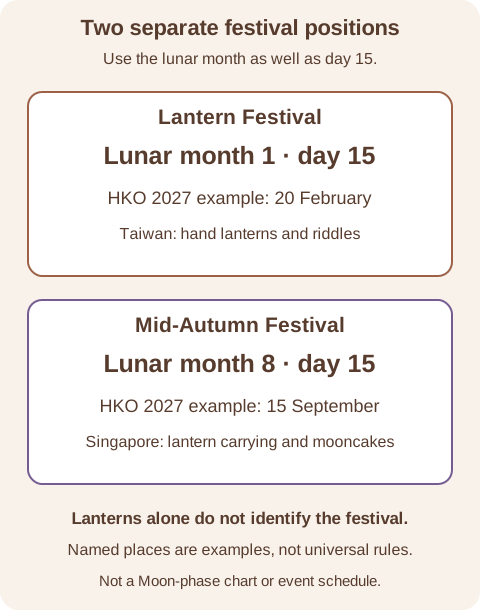
A lunar month is not a Gregorian month with a different label. Do not replace “first lunar month” with “January” or “eighth lunar month” with “August.” Nor should you copy the 2027 Gregorian dates into a notice for a different year. Use that year’s reliable conversion table.
The illustration deliberately avoids drawing seven equal blocks between the festivals. The Chinese calendar is lunisolar, and a fixed number of Gregorian days or a universal elapsed-month shortcut would need separate justification. For this comparison, identifying month 1 versus month 8 is sufficient.
The fifteenth is traditionally associated with a full Moon, but a calendar day and the exact astronomical full-moon instant are different things. The cultural symbolism of fullness and reunion does not guarantee an exact phase, cloud-free weather or a visible Moon during your gathering.
Ask what the lantern is doing in this particular account
The same object can have different roles. Taiwan’s Tourism Administration describes Lantern Festival riddles, rice-flour dumplings and colourful displays. It also distinguishes carrying hand lanterns from the modern Taiwan Lantern Festival’s themed displays and performances, and identifies Pingxi as a particular sky-lantern tradition. [2]
For Mid-Autumn in Singapore, the National Heritage Board describes children carrying lanterns in neighbourhoods. Its account places that activity alongside family and community gatherings, mooncakes and other foods. Hong Kong Tourism Board also associates Mid-Autumn with glowing lantern carnivals and displays. [3,4]
These accounts explain why “lanterns are present” is too broad a test. A useful description says what people are doing, where, and at which occasion: carrying hand lanterns in a Singapore Mid-Autumn account is different from identifying a named Taiwan Lantern Festival display. Neither needs to be treated as a mistaken version of the other.
A sky lantern is also not the default meaning of every lantern in these sources. A description of Pingxi does not instruct you to release one elsewhere. For an activity involving equipment, fire or public space, follow the actual organisers’ arrangements and local rules; a cultural comparison cannot supply permission.
Use foods as contextual clues, then check the label
Rice-flour dumplings in Taiwan’s Lantern Festival description and mooncakes in Mid-Autumn accounts are useful contrasts. They are different food categories, even when roundness is associated with togetherness. A round shape alone does not tell you the name, ingredients or festival. [2–4]
Names such as tangyuan and yuanxiao may appear in discussions of Lantern Festival foods. Keep the actual food’s supplied name when describing it; do not infer a preparation method or filling from a broad festival label. A bowl of rice-flour dumplings is not a mooncake merely because it is served at a reunion.
NHB describes traditional and newer mooncake forms in Singapore, including changing fillings and styles. That variety means a familiar pastry photograph cannot establish every ingredient. For buying or sharing food, read the actual product information and ask about ingredients relevant to the people eating it, rather than using this cultural table as a recipe or dietary check.
Food is supporting context, not exclusive proof. A bakery can sell mooncakes outside the festival, and a family can eat a familiar food at another time. Combine the food label with a named occasion, year and place before writing a confident caption.
Keep Taiwan, Hong Kong and Singapore examples attached to their place
| Place and source | What the account supports | What to avoid inferring |
|---|---|---|
| Taiwan: Tourism Administration | Lantern Festival hand lanterns, riddles and rice-flour dumplings; distinct public events, including Pingxi. | One national venue or programme for every lantern activity; generic old venues as current bookings. |
| Hong Kong: Tourism Board | Mid-Autumn mooncakes, moongazing, lantern activities and the named Tai Hang Fire Dragon Dance. | Every display or dance has a confirmed 2027 time, venue or ticket arrangement. |
| Singapore: NHB inventory | Mid-Autumn lantern carrying, food sharing and reported family/community practices. | One practitioner’s prayers, offerings or meal are required of all families. |
The NHB account includes an attributed practitioner’s memories and religious practices. Those are valuable personal cultural evidence, not instructions that every reader must follow. Similarly, beliefs about fortune and stories associated with the Moon can be described as beliefs and stories without presenting them as proven causes or a single established historical origin.
A regional comparison becomes more useful when it is specific enough to check. “People use lanterns in Asia” is broad; “NHB describes children carrying lanterns during Mid-Autumn in Singapore” has a clear place, occasion and source. Keep that scope when shortening the sentence for a slide or social post.
Separate a festival identity from a programme date
A named event can run on dates that do not reduce to one traditional calendar day. The Taiwan Tourism Administration’s 2026 Pingxi listing records 27 February and 3 March and identifies the Tourism and Travel Department of New Taipei City Government as sponsor. That is a historical listing for that specific programme, not a 2027 booking. [5]
It shows why two different questions need separate answers: “Which festival tradition is this associated with?” and “When can I attend this named event?” A festival identification can be correct while a copied programme date is out of date. You cannot obtain a new-year venue or schedule by advancing every date in an old notice.
The Hong Kong Tourism Board page checked for this guide has a September 2027 heading and describes lantern and fire-dragon attractions in past tense. That combination does not confirm each attraction’s future dates or admission details. We use the page for its named Mid-Autumn context, not to promise that a particular performance is available when you arrive. [3]
If you are planning a visit, continue to the named organiser’s current announcement. For a fuller worked explanation of a festival date and an event date, see the paired calendar-and-parade example. That guide addresses a separate New Year setting; its dates are not Mid-Autumn dates.
Write a short identification record before a caption
Use this record when a picture, display or lesson note leaves you unsure. It separates the source’s supplied information from your interpretation. “Lanterns at night” belongs under the observed activity; it does not fill in the festival name or year for you.
FESTIVAL IDENTIFICATION RECORD
Name supplied by the source or community:
Chinese lunar month and day, if supplied:
Calendar year / Gregorian conversion source:
Place / community / household or public setting:
Lantern activity actually described:
Food name actually supplied:
Named programme, if different from the festival:
Programme year, if any / unresolved date question:
Source URL / date checked:
Fact I can support:
Interpretation or detail still uncertain:
Caption or comparison sentence with its place retained:
A supported sentence might be: “This source describes children carrying lanterns during Mid-Autumn in Singapore.” If the image itself has no caption, date or location, a more honest sentence is: “The image shows lanterns; its occasion has not been established.” An unknown field is useful because it identifies what still needs checking.
Download the editable record and six explained cases (TXT). The cases below are original practice examples, not reports of observed events.
Try six festival identification cases
Decide what the information establishes before opening the explanation. When a detail is missing, leave it unknown rather than completing the story from a familiar image.
Case 1
A photograph shows red lanterns but has no location, date or caption. Can it be labelled Lantern Festival?
Show answer and explanation for case 1
The festival is not established.
Lanterns can appear at different occasions, including Mid-Autumn. Look for a supplied name, year, place and context before identifying the festival.
Case 2
A notice says “eighth lunar month, day 15” and describes mooncakes. Which of the two festivals fits that calendar position?
Show answer and explanation for case 2
Mid-Autumn Festival.
The eighth month distinguishes it from Lantern Festival’s first month. Check the year separately before adding a Gregorian date.
Case 3
A Singapore heritage account describes children carrying lanterns during Mid-Autumn. Must the account actually mean Lantern Festival?
Show answer and explanation for case 3
No. Keep the named Mid-Autumn context.
Lantern carrying is documented in that Singapore account. A shared object does not override the source’s named occasion and place.
Case 4
A 2026 Pingxi programme lists two dates. Can either be published as a confirmed 2027 visit date?
Show answer and explanation for case 4
No. The programme year must stay attached to those dates.
A historical listing supports what it explicitly records. A calendar conversion does not establish a future organiser’s schedule, venue or permission.
Case 5
A bowl contains round rice-flour dumplings. Is “mooncakes” a safe caption because both foods can symbolise togetherness?
Show answer and explanation for case 5
No. Preserve or verify the actual food name.
Roundness does not make a dumpling a pastry or identify its ingredients. Check the food label and the occasion independently.
Case 6
Both festivals fall on a lunar day 15. Does that guarantee an exact astronomical full Moon and a clear view that evening?
Show answer and explanation for case 6
No. Calendar position, phase timing and visibility are separate.
Cultural full-moon symbolism does not supply the exact astronomical instant or local weather. A festival can be celebrated without a visible Moon.
Build the comparison around a supported difference
For a short explanation, use three parts: the calendar position, a named local practice, and the limit of the comparison. For example: “Lantern Festival is first-month day 15; Mid-Autumn is eighth-month day 15. Taiwan’s Lantern Festival account and Singapore’s Mid-Autumn account both describe lantern activities, so lanterns alone do not distinguish them.”
For a fuller lesson, ask learners to place the two festivals on the diagram and explain one caption that cannot yet be written confidently. That checks whether they can use evidence, rather than memorise a list of objects. A mooncake, lantern or round dumpling becomes meaningful through its actual name and context.
Use the single-festival guides below for a deeper introduction, and the regional pages for their particular settings. Each page has a different job: this comparison helps distinguish the occasions, while those guides explain what the named occasion or local tradition involves.
Sources and further reading
- Hong Kong Observatory: 2027 Gregorian–Lunar Calendar Conversion TableMonth resets and day-15 rows for the two 2027 calendar examples; not astronomical phases or event bookings.
- Taiwan Tourism Administration: Traditional FestivalsLantern Festival hand lanterns, riddles, rice-flour dumplings and named Taiwan traditions; generic venues and programme descriptions are not current bookings.
- Hong Kong Tourism Board: Mid-Autumn FestivalNamed Hong Kong Mid-Autumn context, mooncakes, lantern activities and Tai Hang Fire Dragon Dance; heading and recaps do not confirm future event details.
- Singapore National Heritage Board: Mid-Autumn Festival inventorySingapore food sharing, lantern carrying and attributed practitioner experiences; no universal required ritual or current programme.
- Taiwan Tourism Administration: 2026 Pingxi Sky Lantern FestivalHistorical 2026 programme with two dates and a named New Taipei sponsor; no 2027 arrangements inferred.