2027 Year of the Goat: Lunar New Year Boundary and Gan-Zhi Label
Revised · Chinese calendar and festival guidance
For the festival-year convention used here, the 2027 Year of the Goat begins on Saturday, 6 February 2027. HKO’s annual table calls the year Ding-wei. Keep the calendar boundary, the stem–branch name and an animal illustration separate; none is a personality profile or a forecast.
The date that matters: 6 February 2027
The Hong Kong Observatory’s 2027 conversion table is headed “Ding-wei – year of the Goat.” Its 6 February row starts the first lunar month and gives Saturday as the weekday. Royal Museums Greenwich independently lists 6 February 2027 and the Goat in its New Year table. This guide uses that Chinese New Year boundary for a public festival-year explanation.
January 1 starts the Gregorian civil year; it does not start this festival-year convention. For a January or early-February date, inspect the cutoff before choosing an animal for a family chart. The 5 February row is still day 29 of the preceding twelfth lunar month. The next row opens the new first month.
Use a declared boundary rather than an unexplained label
Write “using the Chinese New Year boundary” when a birthday note or comparison might otherwise be ambiguous. A civil-year label, a festival-year label and a specialist birth chart are different tasks. HKO’s Gan-Zhi explanation distinguishes labels for years, months, days and hours. A year-only answer cannot supply all of those fields.
HKO’s table also lists Spring Commences on 4 February 2027. That solar-term entry and the first lunar month on 6 February are visibly different rows. Do not substitute one for the other without stating which convention your source uses. This reader checks the festival-year boundary; it does not calculate a specialist chart, an exact birth-time classification or a time-zone conversion.
Three dates around the cutoff
On a narrow screen, scroll this table sideways to read all columns.
| Gregorian date | HKO lunar entry | Festival-year reading | What to write |
|---|---|---|---|
| 5 February 2027, Friday | Day 29, following the twelfth-month reset | Before the new Goat-year opening | Keep the preceding year in this convention |
| 6 February 2027, Saturday | 1st Lunar Month | First day of the new festival year | New Year boundary: Ding-Wei / Goat |
| 7 February 2027, Sunday | Day 2 of the first month | After the new-year opening | Use the same declared convention |
The table is an original reading exercise based on the checked HKO rows. Its purpose is to prevent a January-1 shortcut. It is not a prediction about anyone born on these dates. For a historical birth record, retain the actual calendar, place and date information rather than changing the record to fit a preferred animal.
What Ding-Wei actually adds
Gan-Zhi means the stem–branch naming system. HKO lists ten heavenly stems and twelve earthly branches, paired in a sixty-name cycle beginning Jia-Zi. Ding is one of the stems, Wei one of the branches, and Ding-Wei is the forty-fourth pair in HKO’s displayed cycle. The hyphen and capitalisation vary between its annual header and explanatory table; keep the source wording when quoting.
The animal name is a convenient public year label. The two-part Gan-Zhi name gives the more specific position in the sixty-pair cycle. Twelve animal names and sixty paired names are therefore not competing answers to the same question: they describe different levels of naming.
Use the actual pair when reading a calendar caption: “2027, Ding-Wei, Year of the Goat.” That gives the reader the source’s year name without turning it into a temperament description or life advice.
Goat, sheep and ram wording: preserve what the source says
HKO’s English annual header uses Goat. Royal Museums Greenwich’s annual table also uses Goat, while its general animal-sequence list uses sheep. That gives a concrete reason to preserve a source’s chosen English animal word instead of silently correcting every caption to your preferred term. It does not make a picture an authority for a year’s date.
If an organiser calls a programme the Year of the Ram, quote that programme accurately and explain the calendar context separately. Do not rename a proper event title or infer its date from an animal drawing. A broad “goat or sheep” note can help explain English wording, but the precise source and job still belong in the sentence.
A useful family card or classroom caption
Begin with the occasion and date, then add the year label if it helps: “Chinese New Year begins on 6 February 2027; HKO names the new year Ding-Wei, Year of the Goat.” A simple animal drawing can accompany that caption. State that it is an original illustration rather than a historic object, regional ritual design or authentic costume.
For a class chart, ask learners to place 5 and 6 February on opposite sides of the festival-year boundary and explain why the same Gregorian year appears on both sides. That task checks an actual distinction. It is more useful than asking children to assign personality traits to classmates from their year labels.
The year label does not organise the whole festival
UNESCO’s Spring Festival account describes preparation, a New Year’s Eve family meal, greetings and community practices. Those social activities supply the celebration’s context. An animal motif can decorate a card or chart; it does not dictate a family’s dishes, a compulsory gift, a parade date or the length of a school holiday.
Keep those questions on their own paths. Use the Chinese New Year guide for reunion and customs. Use the date-checking reader for a calendar lookup. Use the actual host or organiser’s announcement for a meal or public programme. The blank record below is for source and caption notes, without collecting a person’s birth details on this page.
2027: boundary before animal label
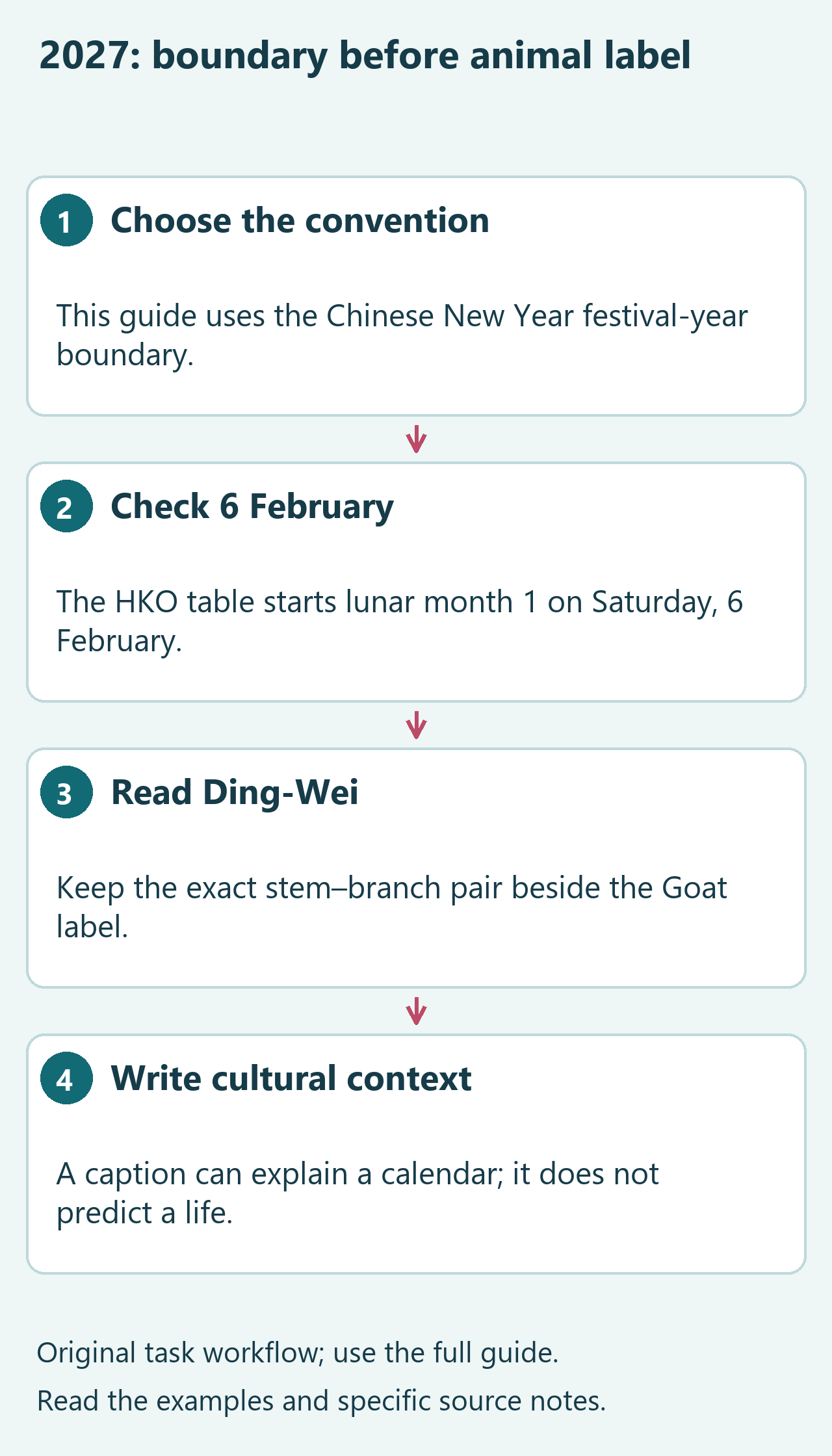
Examples to work through
These original examples show how to use the source, setting and information actually available.
A family chart begins every animal year on 1 January
For the declared festival-year convention, revise the cutoff. A date before 6 February 2027 is still before the new lunar year. Preserve the real date and state the convention instead of assigning Goat from the civil-year number alone.
A note treats 4 February as the festival opening
The HKO table lists Spring Commences on 4 February and the first lunar month on 6 February. They are separate entries. Identify the intended convention; use 6 February for the Chinese New Year boundary explained here.
A calendar says Goat and an event says Ram
Keep each source’s supplied wording. A quotation of an event title should retain its title; a calendar explanation can identify HKO’s Goat label. Neither animal word confirms that event’s date, venue or booking.
A caption calls a child gentle because of the year
Remove the personality assignment. A useful caption explains the date boundary, animal motif or Ding-Wei name. The calendar evidence does not establish a child’s character, future or compatibility.
2027 boundary and cultural caption record
Use these optional reminders to mark fields you want to keep in your own notes. The downloadable blank sheet contains every record field. Keep your completed record in your own notes.
Frequently asked questions
When does the 2027 Year of the Goat begin?
Using the Chinese New Year boundary in this guide, Saturday, 6 February 2027. That is the first lunar month’s first day in HKO’s annual table.
What is the Gan-Zhi name for 2027?
HKO’s 2027 header gives Ding-wei. Its sixty-pair table displays Ding-Wei as pair 44. Keep the stem–branch label separate from an animal illustration.
Is Spring Commences the same date in 2027?
No. HKO lists Spring Commences on 4 February and the first lunar month on 6 February. State the convention rather than silently substituting one boundary for another.
Does this tell me someone’s personality or future?
No. The reader explains calendar names and cultural captioning. It provides no temperament, compatibility, health, money or personal forecast.
Sources and what they support
- Hong Kong Observatory: 2027 Gregorian–Lunar Calendar Conversion Table
2027 Ding-wei/Goat header, lunar month resets, Gregorian dates and weekdays, and separate solar-term entries. Calendar conversion does not supply an event schedule or days off.
- Hong Kong Observatory: Heavenly Stems and Earthly Branches
Ten stems, twelve branches and the sixty-pair Gan-Zhi cycle, including Ding-Wei. Year, month, day and hour names are different fields; a year label is not a personal forecast.
- Royal Museums Greenwich: Lunar New Year dates and animal years
Chinese lunisolar-calendar explanation, 2027 New Year date and Goat label, plus a Hong Kong red-packet example. A particular example does not establish every household’s practice.
- UNESCO: Spring Festival, Chinese New Year social practices
Chinese cultural scope, first-month day 1, preparation, reunion and greetings. The public entry was inscribed in 2024; its summary describes practices without requiring every family to follow one script.
Calendar tables support the identified year and calendar entry. Cultural sources describe their named communities and examples. Preparation tables, worked cases, blank records and diagrams are original aids. Public events and personal arrangements need their own current confirmation.