Practical guide
Why a Solar Term Can Have Different Dates in Different Time Zones
A solar term marks one astronomical instant, but local clocks can put it on different days. The 2027 equinox is 21 March at 04:25 in Hong Kong and 20 March at 20:25 UTC.
On this page
Compare the complete timestamp, not only the day
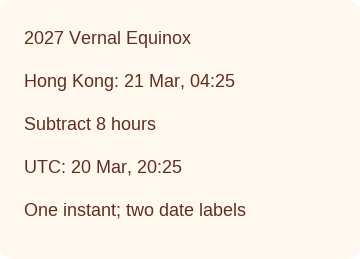
Two different date labels can describe the same solar-term instant. For example, HKO gives Vernal Equinox in 2027 as 21 March at 04:25 Hong Kong Time. Hong Kong Time is eight hours ahead of UTC, so that instant is 20 March at 20:25 UTC.
A calendar that says “21 March” in Hong Kong and one that says “20 March” in UTC are therefore not necessarily disagreeing about astronomy. They may be displaying the same event on different local clocks. Before choosing which label to copy, identify the year, term, complete time and time standard.
The Observatory’s time-table page explicitly states that its times are in Hong Kong Time, eight hours ahead of Coordinated Universal Time. Its public annual data supplies month, day and hour/minute fields; the page’s loader supplies the term labels in order. The examples below use that actual combination.
Convert Hong Kong Time to UTC
To convert the displayed HKO time to UTC, subtract eight hours while keeping the same instant. If that passes midnight, adjust the date as well as the hour. For the 2027 equinox, 21 March 04:25 minus four hours is 21 March 00:25; subtracting the remaining four hours gives 20 March 20:25 UTC.
A useful check is to reverse the calculation: 20 March 20:25 UTC plus eight hours becomes 21 March 04:25 Hong Kong Time. Both directions must agree. Writing “21 March 20:25 UTC” would retain the old date after crossing midnight and describe a different instant, one day late.
Use the precision that the source gives. These HKO records are displayed to the minute. Do not add invented seconds or present the examples as a second-level prediction. If comparing another provider, keep its original precision, year and stated time basis visible.
For another local zone, convert the UTC instant using that location’s applicable rules on the event date. A zone’s seasonal clock changes may matter. The worked table here compares only Hong Kong Time and UTC; it does not establish every country’s local conversion.
Check three published term records
On a narrow screen, swipe inside this table. You can also focus it and use the arrow keys.
| Term and year | HKO: Hong Kong Time (UTC+8) | Same instant in UTC |
|---|---|---|
| Spring Commences, 2026 | 4 February 2026 04:02 | 3 February 2026 20:02 |
| Vernal Equinox, 2027 | 21 March 2027 04:25 | 20 March 2027 20:25 |
| Winter Solstice, 2026 | 22 December 2026 04:50 | 21 December 2026 20:50 |
All three conversions cross into the preceding UTC date because the Hong Kong hour is earlier than 08:00. That does not mean every solar term needs a one-day adjustment. A Hong Kong timestamp after 08:00 can convert to UTC on the same date.
For a same-date check, HKO’s 2026 Vernal Equinox is 20 March 22:46 Hong Kong Time. Subtracting eight hours gives 20 March 14:46 UTC. The rule is to convert the full timestamp; “always subtract one calendar day” is not a conversion rule.
These are annual records, not permanent dates attached to names. In Hong Kong Time the equinox is 20 March in the selected 2026 table and 21 March in the selected 2027 table. Verify the year before attributing every disagreement to time zones.
Decide whether two date labels actually disagree
First match the term’s identity and the source year. “Spring Commences” and “Vernal Equinox” are different entries. Likewise, a 2026 row and a 2027 row cannot be compared as if they describe the same occurrence.
Next retain each complete original timestamp and convert both to one common time standard. If one source only prints a date, record that missing precision. A date-only label may be compatible with a timestamp but cannot establish that the minute agrees.
Worked comparison: one source lists the 2027 equinox as “21 March 04:25, Hong Kong Time,” and another lists “20 March 20:25 UTC.” The conversion above shows equality at the stated minute precision. The civil-date difference is explained.
If the second source instead says “21 March 20:25 UTC,” conversion gives 22 March 04:25 Hong Kong Time. That is a full day away from the HKO entry. Check transcription, year, term and original source details; do not label it a time-zone difference merely because the hours differ by eight.
When a discrepancy remains after those checks, preserve the actual source statements rather than averaging two times or silently moving a date. You may need the source’s calculation basis or a corrected original record. A calendar guide should make the unresolved point visible.
Keep an instant separate from a cultural event
An astronomical term instant does not tell you when a family meal, school activity, tomb-sweeping visit or public celebration starts. Those activities have their own schedules and local practices. A community can observe a solar term on a convenient day without claiming to change the astronomical instant.
If you are labelling an astronomy chart, retain the exact year and chosen time standard. If you are creating an invitation, use the organiser’s actual local event time and make the cultural connection clear. Do not replace an announced event date with a converted solar-term timestamp.
For seasonal meanings and customs, use the individual term guides. To understand why the terms themselves are not fixed 15-day repeats, read the angular-spacing and interval guide.
Case 1
Hong Kong says 21 March 04:25 and UTC says 20 March 20:25 for the 2027 equinox. Which is wrong?
Show answer and explanation for case 1
Neither date is wrong on that information: they describe the same instant.
Subtracting eight hours from the Hong Kong timestamp crosses midnight into 20 March UTC. Compare the complete timestamps.
Case 2
Should every HKO term date be moved back one day when using UTC?
Show answer and explanation for case 2
No. Convert the time, then let any midnight crossing determine the date.
The 2026 equinox at 22:46 Hong Kong Time becomes 14:46 UTC on the same 20 March date.
Case 3
Does converting the winter-solstice instant specify when a local Dongzhi dinner must start?
Show answer and explanation for case 3
No. The dinner needs its own actual schedule.
An astronomical instant and a cultural event time answer different questions. Use the organiser or household arrangement for the meal.
Sources and further reading
- Hong Kong Observatory: Date and Time of the 24 Solar TermsStates the Hong Kong Time basis, eight hours ahead of UTC, and the astronomical-data attribution.
- Hong Kong Observatory: 2026 solar-term data (XML)Actual annual entries for Spring Commences, Vernal Equinox and Winter Solstice used in the conversions.
- Hong Kong Observatory: 2027 solar-term data (XML)Actual annual Vernal Equinox entry used in the midnight-crossing example.