Practical guide
Why the 24 Solar Terms Are Not Exactly 15 Days Apart
The 24 solar terms are equally spaced in the Sun’s apparent longitude, not in elapsed days. Two published 2026 intervals show why a fixed 15-day repeat gives the wrong next time.
On this page
Equal angles are not equal days
The 24 solar terms divide the Sun’s apparent path into 24 steps of 15 degrees. They do not divide a year into 24 identical stretches of time. To find the next exact term, use that year’s astronomical table rather than adding 15 days to the previous entry.
Hong Kong Observatory defines these positions using ecliptic longitude. Vernal Equinox is at 0 degrees, Bright and Clear at 15 degrees, Corn Rain at 30 degrees, and the sequence continues around 360 degrees. The longitude describes the Sun’s apparent position as seen from Earth; it is not a measurement of elapsed days.
Earth travels along an elliptical orbit. The 2017 explanation by the Observatory’s director, published by the UNESCO Hong Kong Association, explicitly notes that equal angular distances correspond to different time spans. That is why an equal-angle calendar can have unequal gaps in its published times. You do not need to fit an orbital model yourself to check this: the annual times already show the difference.
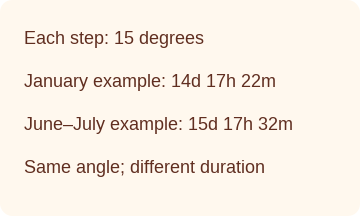
Compare two published 2026 gaps
On a narrow screen, swipe inside this table. You can also focus it and use the arrow keys.
| 15-degree step | Published start → next term | Calculated elapsed time |
|---|---|---|
| Moderate Cold 285° → Severe Cold 300° | 5 January 16:23 → 20 January 09:45 | 14 days 17 hours 22 minutes |
| Summer Solstice 90° → Moderate Heat 105° | 21 June 16:25 → 7 July 09:57 | 15 days 17 hours 32 minutes |
| Difference between the two gaps | 22,652 minutes − 21,202 minutes | 1 day 10 minutes |
These are two selected adjacent pairs from the same 2026 table, using the same time standard and displayed minute precision. Each pair advances the longitude by 15 degrees. The second takes 1 day 10 minutes longer than the first. This is a comparison of two real published intervals, not a claim that those values are a universal minimum and maximum for every year.
The labels follow the Observatory’s English table. Before matching rows from another calendar, check which term each translated label identifies. The major/minor classification guide keeps the astronomical categories separate from adjectives in translated names.
Calculate an interval without rounding away hours
For the January pair, first compare 5 January 16:23 with 20 January 16:23. That would be exactly 15 days. But the actual second time is 09:45, which is 6 hours 38 minutes earlier. Subtract that difference: 15 days minus 6 hours 38 minutes equals 14 days 17 hours 22 minutes.
The minute calculation gives the same result: 15 × 1,440 − (6 × 60 + 38) = 21,202 minutes. Converting that back to days, hours and minutes gives 14 × 1,440 + 17 × 60 + 22 = 21,202.
For the summer pair, 21 June 16:25 to 7 July 16:25 is 16 days. The actual next term is 6 hours 28 minutes earlier, at 09:57. The interval is therefore 16 days minus 6 hours 28 minutes: 15 days 17 hours 32 minutes, or 22,652 minutes.
Keep the year and full timestamp in your calculation, especially when a pair crosses a month or year boundary. Subtract two consistently zoned times. A list containing only “5 January” and “20 January” cannot recover the hours that the list omitted.
Why a fixed 15-day repeat drifts
A repeat starting at 5 January 2026 16:23 and adding exactly 15 days predicts 20 January 16:23. The published Severe Cold entry is 20 January 09:45. The repeat is already 6 hours 38 minutes late after one step, even though its date label still looks correct.
Starting at 21 June 16:25 and adding 15 days predicts 6 July 16:25. The published Moderate Heat entry is 7 July 09:57. This time the repeat is 17 hours 32 minutes early and gives a different civil date. A date-only comparison hides the first error but reveals the second.
Dividing a mean year length by 24 produces an average interval, not the actual timetable. It cannot tell you which successive gaps are longer or shorter, or the minute when a specific term begins. Use averages to understand the scale, and an annual source to label an exact instant.
A classroom observation or family meal can still be scheduled on a convenient day. Describe it as your activity date. A chosen event schedule does not become an astronomical calculation merely because the activity refers to a solar term.
What the calculation does and does not show
The calculation explains spacing in time. It does not predict local weather, prescribe agricultural work or establish a cultural celebration’s starting time. For those questions, return to the specific term, local conditions and the responsible event information.
If two sources appear to disagree about a term’s day, first check the year and time standard. The same instant can fall on different civil dates in different places. Use the worked time-zone comparisons before treating a one-day label difference as a calculation error.
Case 1
A 15-degree step took more than 15 days. Has the 24-term system become unequal?
Show answer and explanation for case 1
No. Equal angular spacing and equal elapsed time are different claims.
Both selected steps span 15 degrees. Their actual published durations differ because equal angular distances need not take equal times.
Case 2
Does adding 15 days from the January example reproduce the exact Severe Cold time?
Show answer and explanation for case 2
No. It gives 20 January 16:23, which is 6 hours 38 minutes late.
The actual 2026 HKO entry is 20 January 09:45. Retaining only the date would conceal this discrepancy.
Case 3
Can the two selected 2026 intervals prove every future year’s shortest and longest gap?
Show answer and explanation for case 3
No. They demonstrate unequal intervals in one published year.
A claim about another year or a universal range needs that year’s data or an appropriate broader analysis, rather than these two examples.
Sources and further reading
- Hong Kong Observatory: The 24 Solar TermsDefines the 15-degree steps and lists each term’s solar longitude.
- Hong Kong Observatory: 2026 solar-term data (XML)The actual annual M/D/hm records used for the two calculated intervals.
- Hong Kong Observatory: Date and Time of the 24 Solar TermsExplains the table’s Hong Kong Time basis and astronomical-data attribution.
- UNESCO Hong Kong Association: 24 Solar Terms, April 2017Explains why equal angular distances along Earth’s elliptical orbit correspond to different time spans.