Practical guide
Major and Minor Solar Terms: The 12 + 12 System Explained
The 24 solar terms form two alternating sets of 12. Use solar longitude to identify the category; “minor” or “major” in a translated seasonal name is a separate naming issue.
On this page
What major and minor mean here
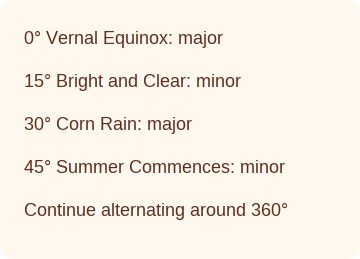
The Chinese 24-term system contains 12 major solar terms and 12 minor solar terms, alternating around the Sun’s apparent path. Hong Kong Observatory’s table places major terms at 0, 30, 60 degrees and so on. Minor terms occupy 15, 45, 75 degrees and the other intervening positions.
Every neighbouring term is 15 degrees from the next. Two successive major terms are 30 degrees apart because a minor term sits between them. The same 30-degree separation holds between successive minor terms. These are categories within the full system; “major” does not mean you should celebrate that term more, and “minor” does not mean the term is inaccurate.
The sequence can be presented from Vernal Equinox because its longitude is 0 degrees. A Gregorian January-to-December list starts elsewhere in the same cycle, with Moderate Cold. Changing where a list begins does not change which terms belong to each category.
Source: [1]
Read the complete paired classification
On a narrow screen, swipe inside this table. You can also focus it and use the arrow keys.
| Major term: longitude and label | Following minor term: longitude and label |
|---|---|
| 0° Vernal Equinox | 15° Bright and Clear |
| 30° Corn Rain | 45° Summer Commences |
| 60° Corn Forms | 75° Corn on Ear |
| 90° Summer Solstice | 105° Moderate Heat |
| 120° Great Heat | 135° Autumn Commences |
| 150° End of Heat | 165° White Dew |
| 180° Autumnal Equinox | 195° Cold Dew |
| 210° Frost | 225° Winter Commences |
| 240° Light Snow | 255° Heavy Snow |
| 270° Winter Solstice | 285° Moderate Cold |
| 300° Severe Cold | 315° Spring Commences |
| 330° Spring Showers | 345° Insects Waken |
Read each row from left to right, then continue with the next row. After Insects Waken at 345 degrees, the cycle returns to Vernal Equinox at 0 degrees. Zero here is the origin of the longitude scale; it is not an extra twenty-fifth term.
This chart deliberately uses the Observatory’s English labels, so that you can match its definition table to its annual time table. Other guides may translate the same seasonal names differently. A translation should be checked by the identity of the term, rather than by assuming that a familiar adjective settles the category.
Source: [1]
Separate category from seasonal adjectives
Moderate Heat is at 105 degrees and is a minor solar term; Great Heat is at 120 degrees and is major. That pair can make it seem as though the seasonal adjective always determines the category. It does not.
Light Snow is major at 240 degrees, while Heavy Snow is minor at 255 degrees. Winter Commences is minor at 225 degrees, while Winter Solstice is major at 270 degrees. The reliable rule is the term’s position in the alternating longitude sequence, not the apparent importance or intensity of its English name.
Avoid using “major solar term” as a substitute for “one of the 24 solar terms.” The broad collection includes both categories. When a source specifically discusses a major term in a lunar month, it is referring to the 12-member set, rather than to whichever of the 24 happens to occur nearby.
For a reader-facing caption, a precise wording is: “Heavy Snow, a minor solar term at 255 degrees in the HKO classification.” That identifies the seasonal name and the astronomical category separately. It does not claim snow will fall in your location.
Source: [1]
Why major terms matter to a lunar-solar calendar
The Agricultural Calendar combines lunar months with the solar year. HKO’s calendar explanation describes a synodic month as the interval between successive new moons or full moons and explains why 12 lunar months are shorter than a tropical year. Intercalation keeps the two cycles coordinated.
Its solar-term overview explains the ordinary role of major terms in that arrangement: a lunar month without a major solar term is treated as a leap month of the preceding month. Notice the category. “No major term” is not the same statement as “no term of either kind.” A minor term does not become a major term just because it is the only nearby one in a table.
Use that explanation to understand why the distinction matters. Do not turn a short overview into a complete program for assigning every leap month. The 2017 UNESCO Hong Kong explanation itself says this practice remains generally valid in most situations. Full calendrical construction, boundary cases and exceptional years require the applicable detailed rules and actual astronomical data.
For a concrete already-published calendar example, read why a Chinese calendar can repeat a lunar month. That article compares labelled month blocks. This chart explains the solar-term categories; it does not independently recalculate that historical calendar.
Use the chart without inventing an exact date
The longitude table identifies the terms and their categories. It does not tell you the date and minute for a particular year. Take the annual time from an annual source, then retain its time standard. HKO publishes solar-term times in Hong Kong Time, UTC+8.
Source: [4]
Nor does a 15-degree step mean exactly 15 days. The interval guide compares two actual 2026 pairs and shows the difference. If a term appears on different civil dates in two calendars, check the time-zone guide before calling one date wrong.
Case 1
Is Heavy Snow major because its English name sounds stronger than Light Snow?
Show answer and explanation for case 1
No. Heavy Snow is minor at 255 degrees; Light Snow is major at 240 degrees.
The category follows the alternating longitude positions. Seasonal adjectives do not provide a general classification rule.
Case 2
Does a month containing a minor term necessarily contain a major term?
Show answer and explanation for case 2
That conclusion does not follow from the category alone.
The two sets are distinct. To determine what lies inside a particular lunar month, compare its actual boundaries with the appropriate term instants under the applicable calendar rules.
Case 3
A January-first list puts Moderate Cold before all other terms. Does that make it a major term?
Show answer and explanation for case 3
No. Moderate Cold remains minor at 285 degrees.
The place where a printed list starts is a presentation choice; it does not change the solar longitude or category.
Sources and further reading
- Hong Kong Observatory: The 24 Solar TermsThe complete major/minor classification, solar longitudes and introductory intercalation explanation.
- Hong Kong Observatory: The Chinese Agricultural CalendarExplains the combined lunar-solar calendar and the tropical-year/synodic-month distinction.
- UNESCO Hong Kong Association: 24 Solar Terms, April 2017Provides historical context and qualifies the ordinary leap-month explanation as generally valid in most situations.
- Hong Kong Observatory: Date and Time of the 24 Solar TermsStates that the annual table’s times are Hong Kong Time, eight hours ahead of UTC.